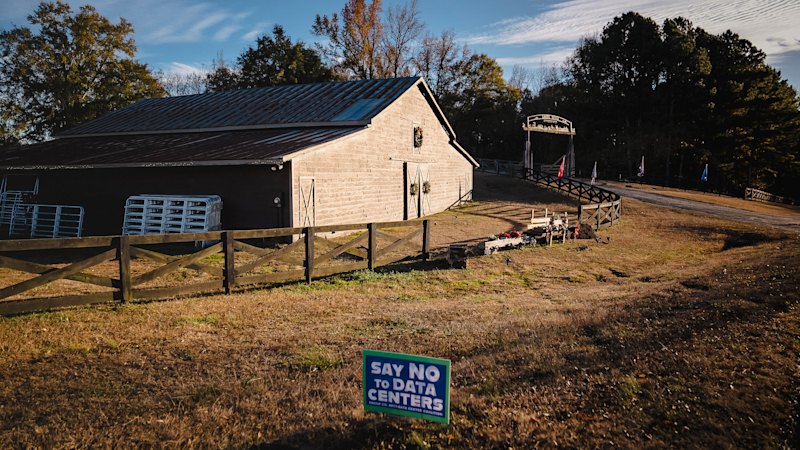
Voters in Georgia are redefining political allegiances as rising utility bills and concerns over data centre developments shape their decisions. In the recent elections, some traditionally Republican voters crossed party lines, contributing to significant victories for Democratic candidates on the Georgia Public Service Commission. This shift reflects growing dissatisfaction with utility costs and the expanding influence of the artificial intelligence industry in the region.
Reece Payton, a cattle farmer from Hogansville, Georgia, expressed his frustration over escalating electric bills, including an additional charge of $50 monthly for a nuclear power plant located over 320 kilometres away. Payton, who voted Democratic for the first time, was particularly concerned about a proposed data centre near his family’s Logos Ranch, approximately 100 kilometres southwest of Atlanta. “That’s the first time I ever voted Democrat,” he stated, highlighting the urgency felt by many voters regarding utility issues.
The Democrats, Peter Hubbard and Alicia Johnson, achieved notable upsets in November, marking the first time since 2007 that a Democrat has held a position on the commission, which oversees utility regulation and energy policy. Their victories resonate beyond state lines, as similar sentiments arise across the United States. In Virginia, incoming governor Abigail Spanberger promised to address energy costs and impose higher taxes on data centres. In New Jersey, Mikie Sherrill aimed to freeze utility rates, while in Memphis, Justin Pearson voiced opposition to a planned supercomputer project from Elon Musk’s xAI in a predominantly black neighbourhood.
The growing public outcry against data centres has led to significant political ramifications. Citizens in Tucson, Arizona, successfully halted an Amazon data centre project, while Google also abandoned plans for a facility in Indianapolis due to strong local opposition. Charles Hua, executive director of Powerlines, a nonpartisan organization focused on utility reform, noted, “Electricity is the new price of eggs,” underscoring the need for political leaders to address rising utility costs directly.
According to the American Legislative Exchange Council, Georgia ranks 35th in energy affordability, a situation exacerbated by cost overruns and delays related to the Plant Vogtle nuclear project in Waynesboro. This context prompted Attorney General Chris Carr and Secretary of State Brad Raffensperger to label the November elections a referendum on affordability, with Carr asserting, “You’re a fool if you don’t recognize that.”
Despite the significant losses faced by Republican incumbents Tim Echols and Fitz Johnson, some party members caution against overinterpreting the results. State Senator Greg Dolezal described the election outcomes as an anomaly, drawing attention to the substantial support for Republican candidates in previous elections. He noted, “There’s no planet on which a 65-35 split is representative,” pointing to the need for Republicans to rethink their strategies.
The debate over data centres has intensified in Georgia, where at least 26 facilities are currently under construction near Atlanta, with another 52 planned. While some Republican lawmakers, including Congresswoman Marjorie Taylor Greene, express concerns over resource allocation for these projects, residents have reported negative impacts on local wells and increased municipal water costs.
Good Jobs First, a progressive organization monitoring corporate tax incentives, has criticized the state for inadequate transparency regarding subsidies for data centres. Staff within the public service commission have also warned that residential electricity bills could rise by $20 or more monthly if Georgia Power’s proposal for additional capacity—equal to nine nuclear reactors—is approved. The staff recommended only partial approval of this proposal.
In Troup County, bordering Alabama, the newly elected Democratic utility candidates managed to reduce the previous Republican margins significantly, thanks in part to voters like the Paytons. They became active in local governance after learning about a data centre proposal threatening their farm and surrounding community. “We did not mind data centres, as long as they were placed in industrial areas,” Reece Payton explained, emphasizing the importance of public engagement in such decisions.
The Paytons’ awareness of the political landscape shifted dramatically, and they have since attended multiple local council meetings to voice their concerns. Tina Payton, motivated by a Democratic congressional candidate’s pledge to support the Anti-Data Centre Coalition, encouraged community involvement in upcoming forums.
Reece Payton attributed the current situation to former President Donald Trump’s push for data centre growth, stating, “Kemp jumped on the bandwagon, and these guys that were in there were doing nothing more than what Kemp was telling them.” This sentiment encapsulates the broader political shift occurring in Georgia, as voters demand accountability and responsive leadership on utility costs and local developments.