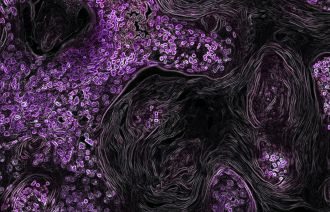
Researchers at the University of Duisburg-Essen have developed an innovative method for creating lung organoids in large quantities, potentially transforming the field of lung disease research. These mini lungs, produced through a simple, automated process, could lead to more effective testing of treatments and personalized medicine.
The study, published in Frontiers in Bioengineering and Biotechnology, outlines how the new technique utilizes a tank filled with oxygen-infused growth medium that is continuously stirred. This method allows for the mass production of organoids that replicate the cellular makeup of real lungs more accurately than traditional cell lines. Importantly, using a patient’s own cells to create these organoids could facilitate the testing of tailored treatments before patients undergo actual medical procedures.
Professor Diana Klein, the lead author of the study, stated, “The best result for now — quite simply — is that it works.” She emphasized that this automated process could significantly enhance the efficiency of producing lung organoids, which are crucial for understanding lung diseases and developing new medications.
Advancing Lung Disease Research
Lung diseases remain a leading cause of mortality worldwide, and finding effective treatments is vital. The complexity of lung structures has made it challenging to create accurate models for research. Lung organoids, which are clusters of cells resembling actual lung tissue, offer a promising alternative but have previously required labor-intensive techniques that limited their use in preclinical testing.
Klein explained the process: “You take a starting cell, in our case the stem cell, and multiply it — the cells grow in a suitable plastic dish.” Once a sufficient number of cells have developed, they are detached and encouraged to form aggregates known as embryoid bodies. These structures are then exposed to various growth factors that facilitate the transformation into different lung cell types.
The researchers placed these embryoid bodies into a bioreactor, allowing for a controlled environment to promote organoid development. After four weeks, both the bioreactor-grown organoids and a control set grown manually were analyzed through microscopy and RNA sequencing, confirming that both sets developed lung-like structures, including airways and alveoli.
Future Implications for Personalized Medicine
The ability to produce more organoids with less manual intervention could significantly enhance research into lung diseases. As the study indicates, lung organoids could be instrumental in high-throughput testing of experimental drugs, evaluating their effectiveness and appropriate dosages. This capability could hasten the development of targeted therapies for patients.
“The organoids could also be used to predict patient-specific reactions to radiotherapy or other potential treatments,” Klein noted. This aspect of organoid research could revolutionize how clinicians approach treatment personalization, potentially leading to more successful outcomes for patients.
Despite the promising results, Klein acknowledged that there is still work to be done. “Organoids can’t yet fully recapitulate the lung cellular composition,” she said, noting missing components like immune cells and blood vessels. “But for a patient-oriented screening platform, this may not be necessary if important insights into the cells’ fate during a certain treatment can be obtained.”
The researchers are committed to refining their techniques to optimize the production of organoids. Klein stated, “We need robust and scalable protocols for large-scale organoid production.” As they continue to improve their bioreactor design and the conditions for growing organoids, the potential for breakthroughs in lung disease treatment remains significant.
This research, supported by the Federal Ministry of Education and Research (BMBF), represents a crucial step towards more effective therapies for lung diseases, with the power to save millions of lives globally.