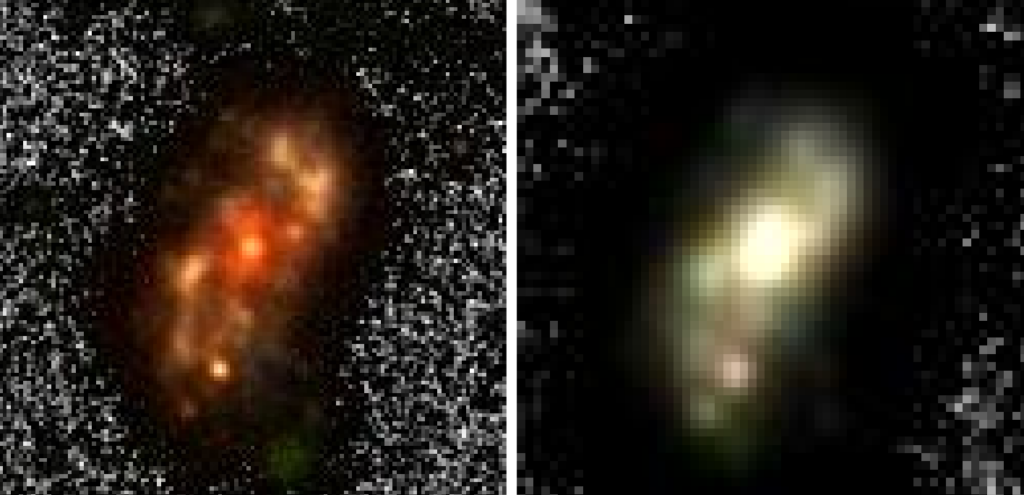
A team of researchers has identified a massive spiral galaxy, named Alaknanda, located approximately 12 billion light-years from Earth. This discovery was made using data from NASA’s James Webb Space Telescope during extensive sky surveys. Alaknanda formed shortly after the Big Bang, when the universe was only about 1.5 billion years old, challenging long-held beliefs about galaxy formation in the early universe.
For years, astronomers maintained that galaxies from this period were too chaotic to develop into well-structured spiral forms. Observations from the Hubble Space Telescope suggested that early galaxies appeared as irregular clumps rather than the smooth disks and arms characteristic of spiral galaxies. The limited observations indicated a scarcity of spiral galaxies dating back more than 11 billion years. The discovery of Alaknanda raises new questions regarding the processes behind galaxy formation.
Yogesh Wadadekar, co-author of the study, emphasized the significance of this finding, stating, “Alaknanda reveals that the early universe was capable of far more rapid galaxy assembly than we anticipated.” He pointed out that this galaxy has managed to gather an impressive 10 billion solar masses of stars into a structured spiral disk within just a few hundred million years, a remarkably rapid process in cosmic terms.
New Insights from Gravitational Lensing
The research, conducted by scientists at the National Centre for Radio Astrophysics of the Tata Institute of Fundamental Research in India, has been published in the journal Astronomy & Astrophysics. The team utilized a phenomenon known as gravitational lensing to observe Alaknanda in unprecedented detail. This effect occurs when the gravity of a massive galaxy cluster magnifies and distorts the light from a more distant galaxy, making it appear brighter.
Alaknanda, spanning approximately 32,000 light-years, features a flat, rotating disk with two prominent spiral arms arranged in a symmetrical, pinwheel shape. These arms are identified as a “grand-design” spiral galaxy, characterized by clear, well-defined structures. The spiral arms contain numerous bright clumps of newly formed stars, resembling beads on a string, indicating areas where gas has collapsed to ignite new stellar activity.
The researchers determined that the stars in Alaknanda are relatively young, averaging only about 200 million years old. By analyzing the galaxy’s brightness across 21 different wavelengths of light, from ultraviolet to infrared, they estimated that nearly half of the stars formed in a rapid burst after the universe reached the one billion-year mark.
Implications for Galaxy Formation Theories
Alaknanda exhibits a star formation rate equal to about 63 suns per year, significantly outpacing the Milky Way’s current rate of star formation. Certain wavelengths of light emit brighter signals, attributed to gas around new stars, which further confirms the galaxy’s intense activity in star production.
Despite the remarkable findings, questions remain regarding the formation of spiral arms in such ancient galaxies. Some theories propose that these arms develop from slow-moving density patterns within the galactic disks, while others suggest gravitational influences from nearby galaxies or substantial gas clumps may play a role.
Interestingly, Alaknanda appears to have a small neighboring galaxy, which could potentially have contributed to its spiral structure. Further observations using the advanced instruments aboard the James Webb Space Telescope, alongside radio telescopes, are planned to study the motions of stars and gas within Alaknanda. This research aims to determine whether the galaxy has settled into its final configuration or if its spiral arms represent an early stage in its evolution.
The discovery of Alaknanda not only provides insight into the formation of galaxies in the early universe but also compels astronomers to reassess existing models related to galaxy development. As new technologies enhance our ability to explore the cosmos, the findings from Alaknanda may lead to a deeper understanding of the complexities involved in galaxy formation and evolution.