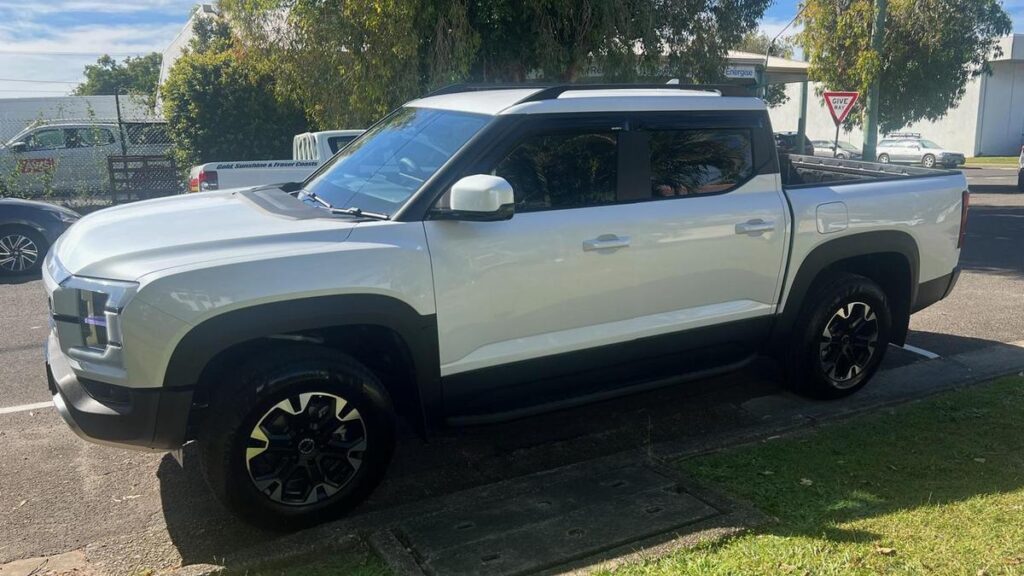
Scott Jones, a diesel fitter from Rockhampton, has made a surprising shift in his vehicle choice, trading his V8 Chevrolet Silverado for a BYD Shark 6 plug-in hybrid ute. Jones, who has a long history of working with diesel engines, found himself needing a vehicle that could meet his current requirements without the heavy towing capabilities he once relied on.
After experiencing difficulties while towing his large boat with his previous vehicle, a Volkswagen Amarok, Jones purchased the Silverado 1500 LTZ in 2021. He appreciated the extra power and space it offered, stating, “It was a powerful V8 and it was spacious and sounded great too.” However, after a few years, he encountered multiple issues with the Silverado, including problems with the fuel pump and water pump, which diminished his trust in the vehicle.
With his boat sold and no longer in need of significant towing capacity, Jones began exploring alternatives. He found himself unimpressed with options from Toyota and Ford and started considering the Shark 6, a new offering from the Chinese manufacturer BYD. The decision to move away from traditional diesel vehicles was significant, as the Shark 6 combines a turbocharged 1.5-litre four-cylinder petrol engine with two electric motors, allowing for an electric-only range of up to 80 km.
Jones was intrigued by the Shark 6’s features and larger tray, which could accommodate his motorcycle trailer with a towing capacity of 2.5 tonnes. Additionally, he anticipated lower running costs compared to the Silverado, particularly if he charged the battery at home.
To experience the vehicle firsthand, he flew to the Sunshine Coast for a test drive. “Those who trash these brands as low quality clearly haven’t sat in one,” he remarked, impressed by the build quality of the Shark 6. He noted that it felt as solid as his Amarok, with no signs of rattling or squeaking.
Jones placed an order for a white Shark 6 in June 2025, and he received it just two weeks later. Since acquiring the vehicle, he has been pleased with its performance, noting it has even outperformed the Silverado in terms of fuel efficiency while towing. He reported achieving an average of 18L/100 km at a speed of 100 km/h, compared to the Silverado’s 24L/100 km.
When discussing his colleagues’ reactions to his switch from a Chevrolet V8 to a Chinese hybrid, Jones said, “Some found it hard to believe what I had done, especially given all my diesel experience.” He invites them to experience the vehicle themselves, stating, “The quality speaks for itself.” He emphasizes the surprising power of the Shark 6, noting it feels as though it possesses 321 kW, which challenges assumptions about smaller engines.
Jones typically charges the Shark 6 overnight, allowing him to utilize its electric range for daily commutes. He appreciates the instant torque and modern technology within the vehicle, although he expressed a desire for additional storage compartments, which were more abundant in his Silverado. While he does miss the distinctive sound of a V8 engine, he feels that the benefits of the Shark 6, including lower fuel costs and comfort, outweigh this drawback.
Reflecting on his purchase, Jones affirmed that he would choose the BYD Shark 6 again, stating, “Sure.” He also expressed interest in future BYD models with enhanced specifications, indicating that he might consider another diesel ute only if it offered exceptional features to compete with the Shark 6.
This story of Scott Jones highlights a growing trend among drivers moving away from traditional diesel vehicles in favor of more innovative and efficient options. As the automotive landscape evolves, vehicles like the BYD Shark 6 are starting to gain traction, particularly among those who have traditionally relied on diesel technology.