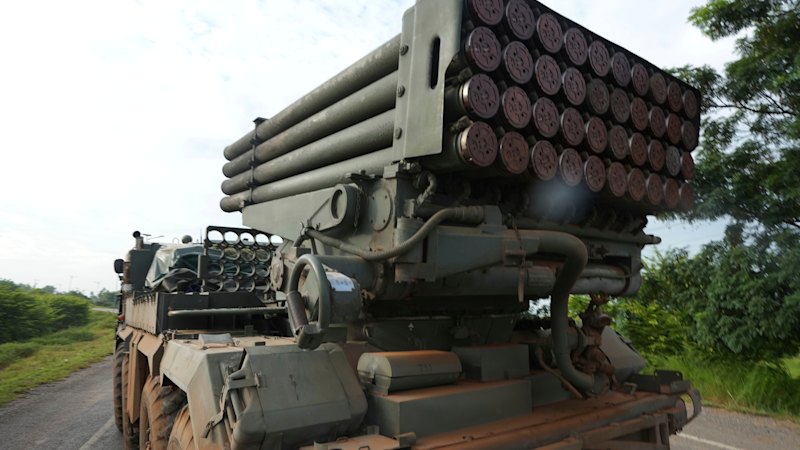
Thailand has initiated airstrikes along its disputed border with Cambodia, escalating tensions that emerged after both nations accused each other of violating a ceasefire agreement brokered by former U.S. President Donald Trump six weeks ago. On the morning of October 30, 2023, the Thai military confirmed it had conducted both air and ground operations following an alleged attack by Cambodian forces that resulted in the death of at least one Thai soldier and injuries to eight others in the eastern province of Ubon Ratchathani.
Military spokesperson Winthai Suvaree stated that the operations targeted only military installations, emphasizing the military’s commitment to civilian safety. “The airstrikes were highly precise and focused only on military targets near the frontline,” he said, asserting that Thai forces acted in response to being fired upon. Despite these claims, Cambodia’s Minister of Information reported at least four civilian deaths and ten injuries resulting from the strikes.
In light of the recent violence, over 35,000 residents have been evacuated to temporary shelters following a brief skirmish on the previous day. Thai Prime Minister Anutin Charnvirakul addressed the nation, stating that Thailand is determined to defend its sovereignty while adhering to international norms. He expressed that the country does not desire violence and has not instigated aggression.
Conversely, Cambodian officials have denied initiating hostilities. Maly Socheata, a spokesperson for the Cambodian Ministry of Defence, accused Thailand of launching surprise strikes on Cambodian territory and urged Thailand to cease actions threatening regional peace and stability.
Background of Tensions and Peace Efforts
The current flare-up represents the most severe conflict since a five-day war in July 2023, which resulted in at least 48 fatalities and displaced approximately 300,000 individuals. The clash was rooted in differing interpretations of a colonial-era map from 1907. Hopes for a peaceful resolution were raised following the signing of the Kuala Lumpur Peace Accord in late October. This agreement was facilitated by Trump, who had threatened to halt trade negotiations if an accord was not reached.
In his remarks, Trump claimed credit for the agreement, stating, “On behalf of the United States, I am proud to help settle this conflict.” He further boasted about his administration’s record in ending conflicts, asserting that they had resolved eight wars in eight months.
Despite these diplomatic efforts, the ceasefire has proven fragile. In November, Thailand announced an indefinite suspension of the peace agreement’s implementation following injuries sustained by troops from land mines.
International Reactions and Future Prospects
With the situation deteriorating, Malaysian Prime Minister Anwar Ibrahim, who played a role in brokering the original ceasefire, urged both nations to exercise restraint and keep communication lines open. He emphasized the importance of utilizing existing mechanisms to maintain peace.
Analysts suggest that domestic political factors in both Thailand and Cambodia are influencing the ongoing conflict. Tita Sanglee, an associate fellow at the ISEAS-Yusof Ishak Institute, pointed out that while the territorial disputes are genuine, the display of aggression is also significant. She indicated that although both nations might soon face pressure from ASEAN and major international powers like the United States and China, the current round of conflicts could be more intense than previous encounters.
She noted, “The Thai-Cambodian conflict is not going to end conclusively. It is episodic and recurring.” As tensions rise, it remains to be seen how both countries will navigate this latest escalation and whether further diplomatic efforts can restore stability in the region.