




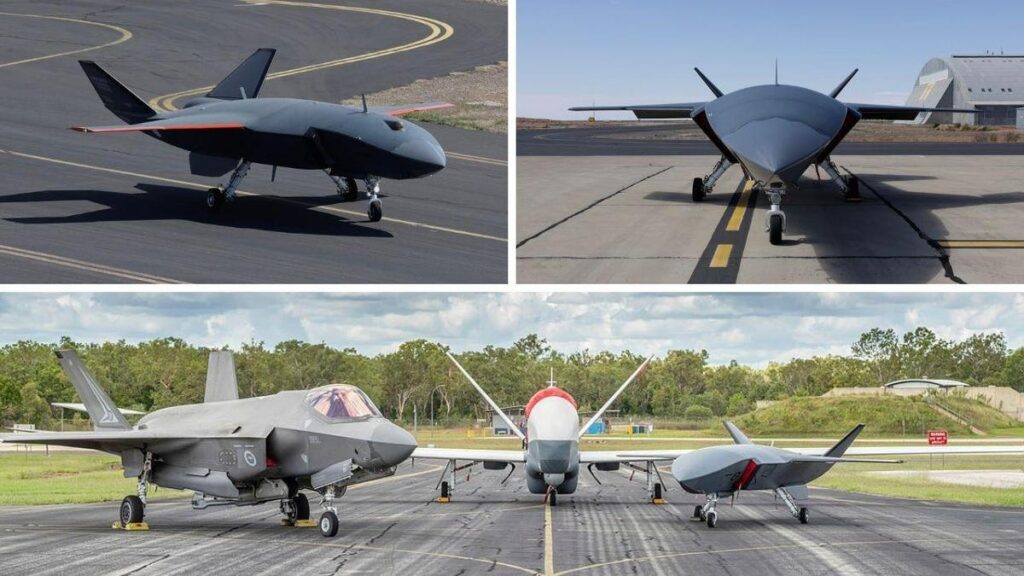
URGENT UPDATE: Australia is making a historic move by committing over $1 billion to advance the production of the MQ-28A Ghost Bat, the nation’s first home-grown combat aircraft in over 50 years. The announcement, expected to be made later today, marks a pivotal step in enhancing the Australian Defence Force’s (ADF) air capabilities.
The funding will establish fresh contracts with Boeing Defence Australia to develop an initial fleet of six operational Block 2 Ghost Bats. This shift from prototype to production is crucial for transforming the experimental program into a robust war-fighting platform for the Royal Australian Air Force (RAAF).
This investment is part of a larger $10 billion commitment to drone technology over the next decade, including at least $4.3 billion specifically for uncrewed aerial systems. Since 2019, over $2.34 billion has already been invested in the Ghost Bat project, with the federal government contributing $1.72 billion in just the past two years.
The Ghost Bat is designed as a sleek, autonomous “loyal wingman” that will fly alongside advanced fighter jets, significantly enhancing Australia’s combat capabilities. It is the first combat aircraft that has been designed, engineered, and manufactured in Australia in over five decades. Currently, the program supports more than 440 highly skilled jobs across the country, involving over 35 Australian companies in its development.
Equipped with advanced sensors and artificial intelligence, the MQ-28A is classified as a Collaborative Combat Aircraft. It can perform missions traditionally handled by fighter jets, effectively multiplying the combat power of a single fighter within a networked team. The Ghost Bat will integrate with crewed aircraft including the Joint Strike Fighter and Super Hornet, enhancing operational effectiveness.
The RAAF describes the Ghost Bat program as a “pathfinder” for integrating autonomous systems with human-machine teams. With a range of over 3700 km, the aircraft is purpose-built to explore levels of automation and autonomy. A significant 2023 collaboration agreement with the United States has bolstered its development by enabling technology sharing and joint efforts on sensors and datalinks.
Throughout 2025, the Ghost Bat has achieved major milestones, including the simultaneous control of two aircraft by a single operator aboard an E-7A Wedgetail. It has also successfully integrated new sensor payloads and completed operations beyond the Woomera test range, operating from RAAF Base Tindal in the Northern Territory.
As part of its development, the government has indicated that the Ghost Bat will conduct a live air-to-air missile firing against a moving target before the end of the year. This milestone is set to establish the Ghost Bat as a frontline-ready weapon system.
Stay tuned for further updates on this groundbreaking announcement that promises to reshape Australia’s military aviation landscape and enhance national security.
