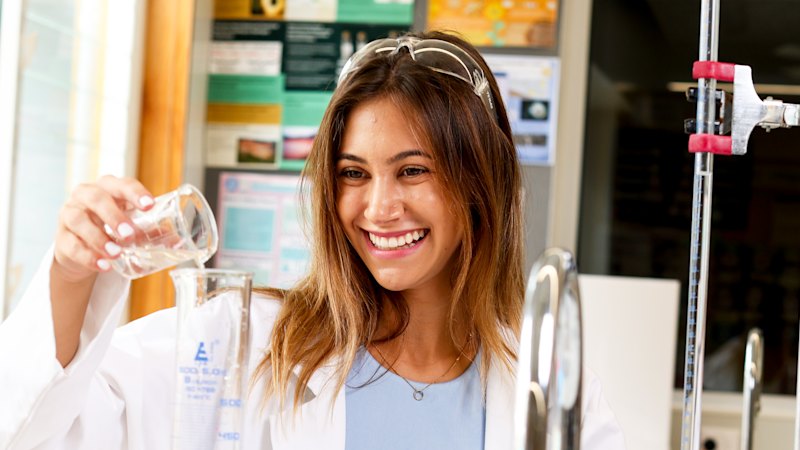
Seventeen-year-old Michaela Loukas has made significant strides in cancer detection by developing an artificial intelligence model capable of identifying cancerous breast tissue with 98 percent accuracy. Her breakthrough came late at night while she was engrossed in her science extension project during the Higher School Certificate (HSC) period. After running multiple tests and receiving consistent results, Michaela felt a mix of excitement and disbelief. “I just couldn’t believe it. I was like, hold up – did I just pick up something pretty significant?” she reflected.
Michaela, a recent graduate from Marist Catholic College in Penshurst, Australia, was awarded the title of 2025 Young Scientist of the Year by the Science Teachers’ Association NSW for her innovative project. Titled “Assessing the Accuracy and Interpretability of a Recurrent Neural Network for Breast Cancer Classification and Molecular Subtyping using Ribonucleic Acid Sequencing Data,” her work demonstrates a remarkable blend of software engineering and biological science.
Breakthrough Findings and Methodology
Michaela’s AI model not only achieved impressive accuracy in detecting malignant tissue but also distinguished between the four most common breast cancer subtypes. While the latter classification achieved an accuracy of 70.6 percent, she noted that it is still not ready for clinical application. “If it was malignant, it also was able to distinguish between the four most common breast cancer subtypes,” she explained, emphasizing the potential for further development.
In addition to its diagnostic capabilities, Michaela’s model highlighted the gene transferrin as a significant factor in breast cancer development. “My AI model detected the gene transferrin as having quite a potentially significant impact when it comes to breast cancer development,” she stated, excited by the validation her findings received from recent studies. “I couldn’t believe it. I was like, ‘Oh my god, oh my god.’ I woke my Mum up!”
The project required nine months of dedicated work. Michaela affectionately refers to it as her “little baby.”
Inspiration and Future Aspirations
Michaela’s passion for STEM began early in her life. At just eight years old, she challenged gender biases by moving a boys’ periodic table T-shirt to the girls’ section of a store, questioning societal norms. Throughout primary school, she participated in a coding club led by a female teacher, which further fueled her interest in technology and science.
Her father, who has battled multiple cancers, served as a personal inspiration for her research. “I was just confused because we’ve got all this science and theory behind cancers, but why are we so stagnant with our treatment options?” she expressed. Although her father is doing well now, he humorously points out that Michaela chose to focus on breast cancer, saying, “Michaela, out of all the cancers I have had, of course you choose the one I don’t have.”
Michaela’s motivation also stems from observing the challenges faced by her friend’s mother, who waited months to learn about her breast cancer diagnosis and treatment options. “By the time you actually receive the information as to whether or not radiation or chemo will be best for her, the cancer’s already progressed, and it’s so costly,” she noted.
Reflecting on her aspirations, Michaela emphasizes the need for equitable access to cancer treatment. “Unless we can find a way to deliver these treatments in a way that can ensure equitable access globally, we are not going to see the advances in healthcare and in our human health as a society that we strive for,” she stated.
Michaela is set to receive her HSC results next week and hopes to pursue a Bachelor of Engineering in Bioinformatics at the University of New South Wales (UNSW). Her groundbreaking work not only highlights her talent but also signifies a promising future in the realm of medical technology and cancer research.