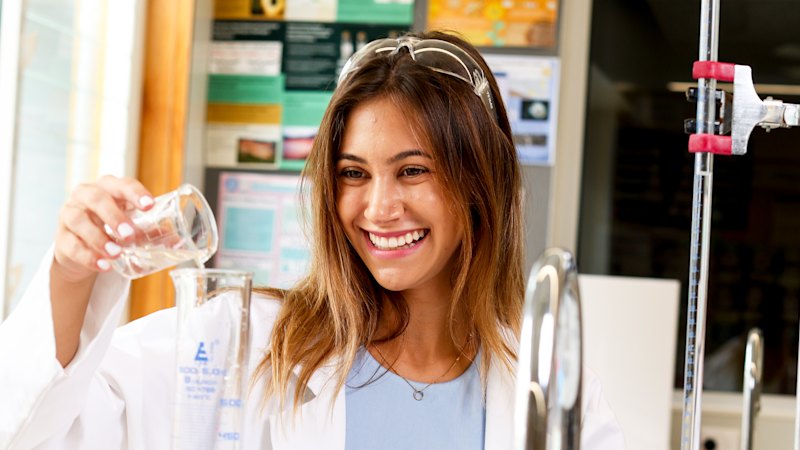
Seventeen-year-old Michaela Loukas has made headlines after developing an innovative AI model capable of detecting breast cancer with an impressive 98 percent accuracy. The breakthrough occurred while she was working on her science extension project, just before midnight. As she reviewed the results, a sense of excitement surged through her, prompting her to retest the model. To her amazement, the results remained consistent.
Loukas, a recent graduate of Marist Catholic College in Penshurst, Australia, was awarded the title of 2025 Young Scientist of the Year by the Science Teachers’ Association NSW for her groundbreaking project. The research, titled “Assessing the Accuracy and Interpretability of a Recurrent Neural Network for Breast Cancer Classification and Molecular Subtyping using Ribonucleic Acid Sequencing Data,” demonstrated her ability to train an AI model for the classification of breast cancer.
The AI model not only distinguished between malignant and healthy tissue but also identified various subtypes of breast cancer. While it achieved 70.6 percent accuracy in this subtyping task, Michaela acknowledges that it is not yet ready for clinical use.
Michaela’s findings align with recent studies, revealing that her model identified the gene transferrin, essential for iron transport in the body, as having a significant impact on breast cancer development. “I couldn’t believe it,” she recalled. “I was like, ‘Oh my god, oh my god.’ I woke my Mum up!”
The project, which took her nine months to complete, reflects Michaela’s long-standing passion for STEM. Her interest was sparked at a young age when she actively challenged gender biases. In primary school, she joined a coding club led by a female teacher who inspired her to pursue technology.
Michaela’s motivation also stems from personal experience; her father has battled four different types of cancer. “I was just confused because we’ve got all this science and theory behind cancers, but why are we so stagnant with our treatment options?” she expressed.
Her father often jokes about her focus on breast cancer, saying, “Michaela, out of all the cancers I have had, of course, you choose the one I don’t have.” Michaela explains that breast cancer was the most accessible dataset for her project. Additionally, her friend’s mother’s struggle to receive timely treatment further fueled her determination.
Michaela advocates for equitable access to healthcare, emphasizing the need for advancements that benefit society as a whole. “Unless we can find a way to deliver these treatments in a way that can ensure equitable access globally, we are not going to see the advances in healthcare and in our human health as a society that we strive for,” she stated.
As Michaela awaits her HSC results next week, she aims to continue her education by pursuing a bachelor of engineering in bioinformatics at UNSW. This innovative work not only highlights her capabilities as a young scientist but also underscores the potential of AI in revolutionizing cancer detection and treatment.