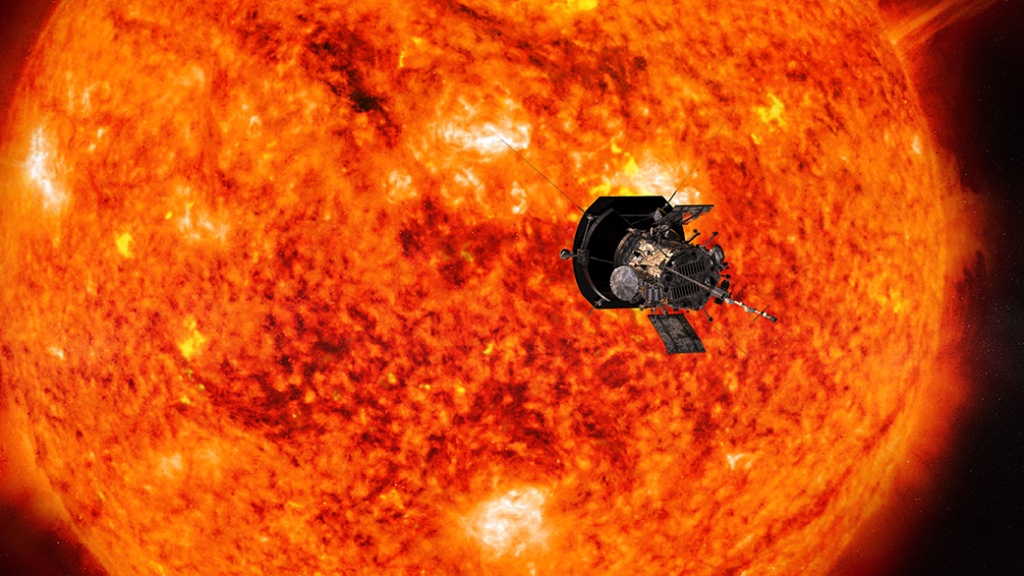
A NASA spacecraft, the Parker Solar Probe, has successfully completed a close approach to the sun, reaching a record distance of 3.8 million miles from the solar surface. This milestone occurred on December 13, 2023, marking the latest perihelion in the probe’s ongoing mission to study the sun’s outer atmosphere, known as the corona. The spacecraft achieved a remarkable speed of 430,000 miles per hour, equivalent to traveling from New York to Tokyo in under a minute, as reported by NASA.
During this flyby, the Parker Solar Probe aims to collect crucial data on solar phenomena, including solar wind, solar flares, and coronal mass ejections. These events are critical to understanding space weather, which can significantly impact technology on Earth. The probe is equipped with four scientific instruments designed to measure solar particles and magnetic fields, providing valuable insights into the sun’s behavior.
Insights from Previous Flybys
This latest encounter follows a groundbreaking flyby in December 2022, where the Parker Solar Probe became the closest human-made object to the sun. Findings and images from that event were published recently in two papers in the Astrophysical Journal Letters. According to Nour Rawafi, the project scientist for the Parker Solar Probe, “Eventually, with more and more passes by the sun, Parker Solar Probe will help us continue building the big picture of the sun’s magnetic fields and how they can affect us.”
The mission, which launched in 2018, has already provided unprecedented data. In 2021, the probe made contact with the sun for the first time, entering a region with temperatures soaring to 2 million degrees Fahrenheit. As scientists continue to grapple with the complexities of space weather, the Parker Solar Probe’s data is essential for improving forecasts of solar events that could disrupt power grids, telecommunications, and GPS systems.
Understanding Solar Activity and Its Impact
The significance of solar flares and coronal mass ejections cannot be overstated. A notable example occurred in March 1989, when a solar flare caused a massive power outage across Quebec, Canada, lasting for approximately 12 hours and disrupting radio signals for Radio Free Europe. These phenomena involve enormous explosions on the sun’s surface, with flares appearing as bright bursts and coronal mass ejections resembling gas fans shooting into space.
NASA describes the distinction between these two events using a military analogy. “The flare is like the muzzle flash, which can be seen anywhere in the vicinity. The coronal mass ejection is like the cannonball, propelled forward in a single, preferential direction, affecting only a targeted area.” The hot plasma from coronal mass ejections typically takes up to three days to reach Earth, traveling at speeds exceeding 1 million miles per hour. When these charged particles interact with the Earth’s magnetic field, geomagnetic storms can occur, impacting technology and infrastructure.
Recent observations from the Parker Solar Probe have revealed that some magnetic material expelled during coronal mass ejections can actually fall back to the sun instead of escaping into space. This discovery suggests a recycling process that reshapes the magnetic environment and may influence the direction of subsequent solar eruptions.
The data collected by the Parker Solar Probe has also facilitated the creation of the first detailed maps of the corona’s boundary, known as the Alfvén surface, where solar material transitions into solar wind. Scientists have noted that this boundary expands and becomes more jagged during periods of heightened solar activity.
As Joe Westlake, NASA’s heliophysics division director, stated, “The insights we gain from these images are an important part of understanding and predicting how space weather moves through the solar system, especially for mission planning that ensures the safety of our Artemis astronauts traveling beyond the protective shield of our atmosphere.”
NASA is currently evaluating the next steps for the Parker Solar Probe in 2026 and beyond, as the mission continues to provide invaluable data about our closest star.