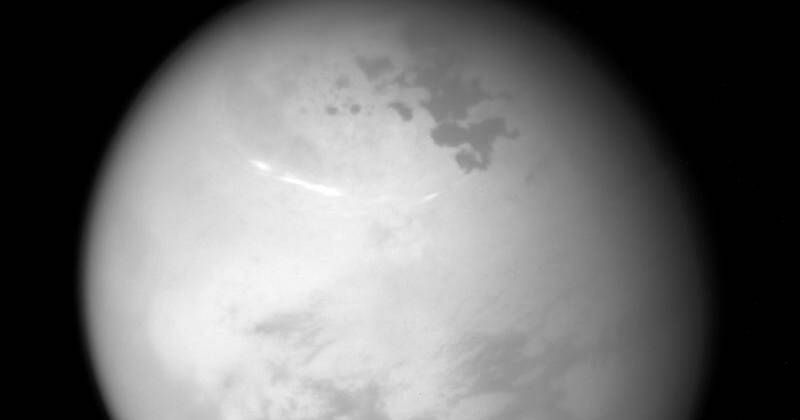
Saturn’s moon Titan may not possess the vast underground ocean that scientists have long believed it to have. Recent research suggests that instead of a global ocean, Titan may contain deep layers of ice and slush, comparable to Earth’s polar regions, with potential pockets of liquid water where life could exist. This revelation was shared by a team led by researchers at NASA’s Jet Propulsion Laboratory on March 15, 2024.
The study revisits data from the Cassini spacecraft, which studied Saturn and its moons for over a decade before concluding its mission in 2017. The researchers emphasize that no direct evidence of life has been found on Titan, the solar system’s second-largest moon, which spans approximately 5,150 kilometers and is known for its lakes of liquid methane on the icy surface. Despite this, the findings present a more optimistic view regarding Titan’s potential for harboring extraterrestrial life.
Baptiste Journaux, a researcher from the University of Washington, commented on the implications of the study, stating, “There is strong justification for continued optimism regarding the potential for extraterrestrial life.” He highlighted the unpredictable nature of life, suggesting that “nature has repeatedly demonstrated far greater creativity than the most imaginative scientists.”
New Insights into Titan’s Structure
Lead author Flavio Petricca from JPL explained that Titan’s supposed ocean may have frozen in the past or is in the process of melting. Alternatively, the hydrosphere may be transitioning toward complete freezing. The team developed computer models indicating that Titan’s layers of ice, slush, and liquid water could extend to depths greater than 550 kilometers. The outer ice shell is estimated to be about 170 kilometers thick, covering slushy layers and pools of water that may extend another 400 kilometers deep, with temperatures potentially reaching around 20°C.
The gravitational influence of Saturn plays a crucial role in shaping Titan’s surface. Because Titan is tidally locked, the same side always faces Saturn, similar to the relationship between Earth and its moon. Saturn’s powerful gravity deforms Titan’s surface, creating bulges that can rise as high as 10 meters. Through enhanced data processing, Petricca’s team measured the timing between Saturn’s gravitational pull and the subsequent surface deformation of Titan.
If a liquid ocean were present, the response would be immediate. However, a delay of 15 hours was detected, indicating a composition of slushy ice with pockets of liquid water underneath. Furthermore, computer modeling of Titan’s spatial orientation supported this theory.
Debate Continues Among Scientists
Despite these findings, some scientists remain skeptical. Luciano Iess from Sapienza University of Rome, who previously indicated the possibility of a hidden ocean on Titan, expressed caution. He described the new study as “certainly intriguing” but argued that the evidence does not currently exclude Titan from being classified as one of the ocean worlds in the solar system.
As research continues, NASA’s planned Dragonfly mission aims to provide further insights into Titan’s internal structure. Scheduled to launch later this decade, the mission will deploy a helicopter-like craft to explore the moon’s surface and gather data that could help clarify its geological and potential biological characteristics.
These developments underscore the ongoing exploration of Titan, a moon that continues to captivate scientists and researchers alike with its complex and mysterious environment.