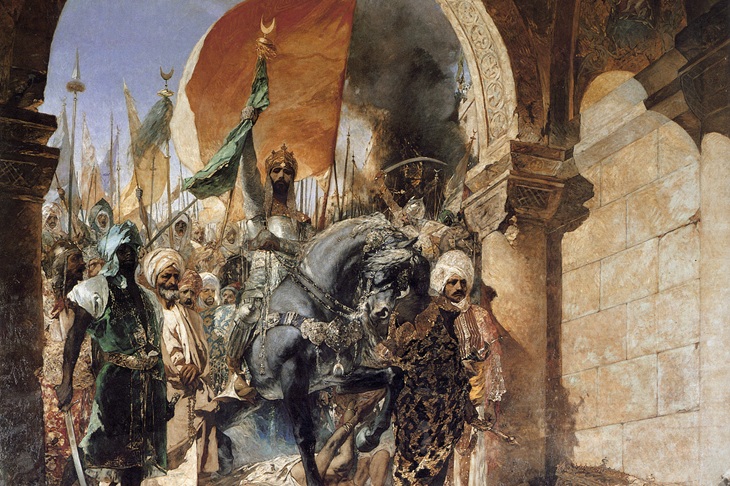
'The Entry of Mehmet II into Constantinople', 1876. The capital of the Eastern Roman Empire since the 4th century AD, Constantinople fell to the Ottoman Turkish army commanded by Sultan Mehmet II in 1453. Found in the collection of the Musée des Augustins (Photo by Fine Art Images/Heritage Images/Getty Images)
The fall of Constantinople in 1453 marked a significant transformation in the political and moral landscape of the region, as the city transitioned from a symbol of Eastern Christendom to a territory under the control of the Ottoman Empire. This event did not merely signify the loss of a metropolis; it represented the replacement of a civilisational order that had endured for over a thousand years. The impact was profound, as the Ottoman conquest altered the very fabric of the region’s governance, law, and identity.
The aftermath of the conquest saw a large number of civilians enslaved, while religious institutions were brought under the authority of the new sovereign law. Notably, the iconic Hagia Sophia was converted into a mosque within days of the city’s fall. Although Christians and Jews were allowed to remain, they were relegated to the status of legally inferior subjects. This change did not result in extermination but rather in a new hierarchy that shifted the civilisational role of the city.
The pattern observed in Constantinople was not unique to this city. In regions where Islamic conquest succeeded politically, the civilisational identity was often permanently altered. For instance, Anatolia, once the heart of Byzantine Christianity, was transformed into a predominantly Islamic region after centuries of Seljuk and Ottoman rule. Similarly, the Levant and North Africa, once vibrant centres of Greco-Roman culture and early Christianity, became Islamic societies that retain this character to this day.
In contrast, areas where conquest was later reversed—such as parts of Spain after the Reconquista or Eastern Europe following the Ottoman retreat—often saw the reassertion of earlier civilisational structures. This historical narrative suggests that the impact of conquest was less about genocide and more about a fundamental replacement of sovereignty and law, with identity evolving accordingly.
Europe’s recognition of this reality came late for Byzantium but became critical during the siege of Vienna in 1683. The siege highlighted that the stakes were not merely territorial but encompassed the future character of European civilisation. The successful relief of Vienna, led by King John III Sobieski of Poland, underscored a moment of clarity for Europe about what was at risk. This victory was not about triumphalism but rather a recognition that civilisations endure when they respond to existential challenges promptly.
Modern Israel stands as a distinct case within this historical framework. Established as a sovereign Jewish state in the Middle East, it has faced persistent threats aimed at reversing its existence. These threats have included targeted acts of terrorism, such as suicide bombings and rocket attacks, which are not aimed at territorial compromise but at undermining civilian life itself.
Despite numerous Israeli withdrawals and territorial concessions, the underlying objectives of these threats have remained unchanged. This ongoing struggle illustrates that mere appeasement has failed to alter the fundamental attitudes towards Israel’s existence. The country’s resilience is rooted not in imperial ambition but in its steadfast commitment to sovereignty, law, and cultural continuity. Israel’s defense is framed as a necessity for coexistence rather than aggression, contrasting with other societies that have faltered under pressure.
The contemporary West grapples with the implications of this historical context. The decline of confidence in established norms has led to the rise of slogans proclaiming that diversity guarantees cohesion, or that coexistence can thrive without reciprocity. These assertions often function as untested articles of faith, urging societies to overlook the conditions that underpin successful pluralism.
The Polish poet Czesław Miłosz articulated a warning about the ‘captive mind’—a phenomenon where educated elites adopt false ideas, equating conformity with virtue and denial with wisdom. This mindset can lead to a weakened defence of inherited institutions, ultimately persuading societies to abandon their own standards for truth.
History does not imply that coexistence is unattainable; rather, it suggests that it demands clarity, reciprocity, and the enforcement of common rules. Where sovereignty is robust and law prevails, pluralism can flourish. Conversely, in situations where authority is ambiguous and confidence erodes, chaos fills the gap.
W.B. Yeats viewed Byzantium as a symbol of a civilisational identity strong enough to endure. The fall of Constantinople exemplifies the consequences of lost sovereignty, while the defence of Vienna illustrates the importance of timely recognition. In this light, Israel’s resistance offers a glimmer of hope that the historical cycle can be broken. The pressing question for the modern West is not whether history will repeat itself, but whether it can be remembered in a timely manner to effect meaningful change.