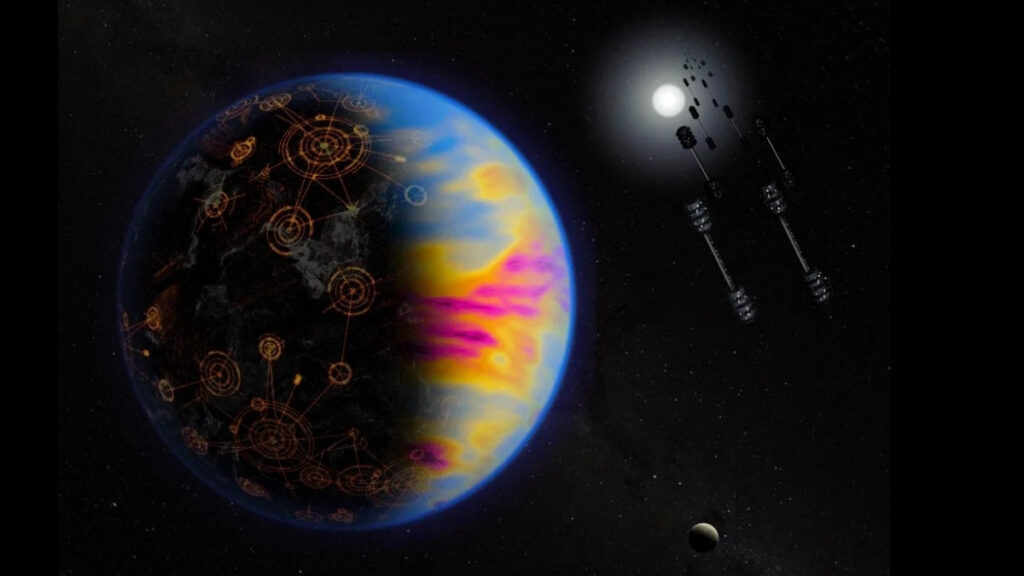
Researchers at Columbia University propose that humanity’s first contact with extraterrestrial intelligence (ETI) may not resemble traditional sci-fi narratives. Instead, it is likely to manifest as a loud, atypical signal, according to a new paper titled “The Eschatian Hypothesis,” authored by renowned astrophysicist David Kipping. This research will be published in the Monthly Notices of the Royal Astronomical Society.
Kipping, who leads the Cool Worlds Lab and hosts a popular YouTube channel focusing on exoplanets, argues that our initial detection of an ETI will be highly unusual and not representative of the broader class of intelligent civilizations. Just as early astronomers discovered exoplanets orbiting pulsars, which are not typical stars, the first signals we detect will likely come from civilizations in extreme conditions.
Understanding the Eschatian Hypothesis
Kipping’s hypothesis draws a parallel between typical astronomical discoveries and the potential for detecting extraterrestrial life. He notes that the first objects we observe often have large observational signatures, making them easier to identify. For example, the very first exoplanets detected were found orbiting pulsars, which emit strong signals that made them stand out. In contrast, the NASA Exoplanet Archive currently lists over 6,000 exoplanets, with fewer than ten identified around pulsars.
Kipping suggests that the initial signals from an extraterrestrial civilization are likely to be similarly “loud.” He refers to the concept of “supernovae”—phenomena that are extraordinarily bright and easily observed due to their transient nature. The study proposes that the first confirmed detection of an ETI will be an atypical example, potentially emerging from a civilization in decline or crisis. The term “Eschatian” is derived from eschatology, which pertains to the end of the world or human existence.
Some scientists speculate that Earth’s current challenges, such as climate change, could be perceived as a loud technosignature of a civilization nearing its end. Kipping raises the possibility that the famous Wow! signal from 1977 might have been an urgent plea from a civilization facing its own eschaton.
Implications for the Search for Extraterrestrial Life
The Eschatian Hypothesis has significant implications for how humanity searches for signs of ETI. Kipping emphasizes that our detection methods should focus on broad, anomalous signals rather than narrowly defined technosignatures. He advocates for high-cadence surveys optimized for detecting generic transients, which may offer the best chance of finding these atypical civilizations.
Advancements in astronomical technology, such as the constant monitoring of the sky by facilities like the Vera Rubin Observatory and the Sloan Digital Sky Survey, place us in a position to detect these unusual signals. Kipping asserts that “agnostic anomaly detection efforts” could lead to significant breakthroughs in understanding extraterrestrial life.
In summary, Kipping’s research challenges the conventional narratives surrounding first contact with alien civilizations. Instead of grand invasions or benevolent beings, humanity may first receive a loud signal indicative of a civilization in a precarious situation. As history has shown, the most detectable phenomena in astronomy are often extreme cases with disproportionately large signatures. Kipping’s insights encourage a rethinking of our approach to the cosmos and the potential messages it may hold.