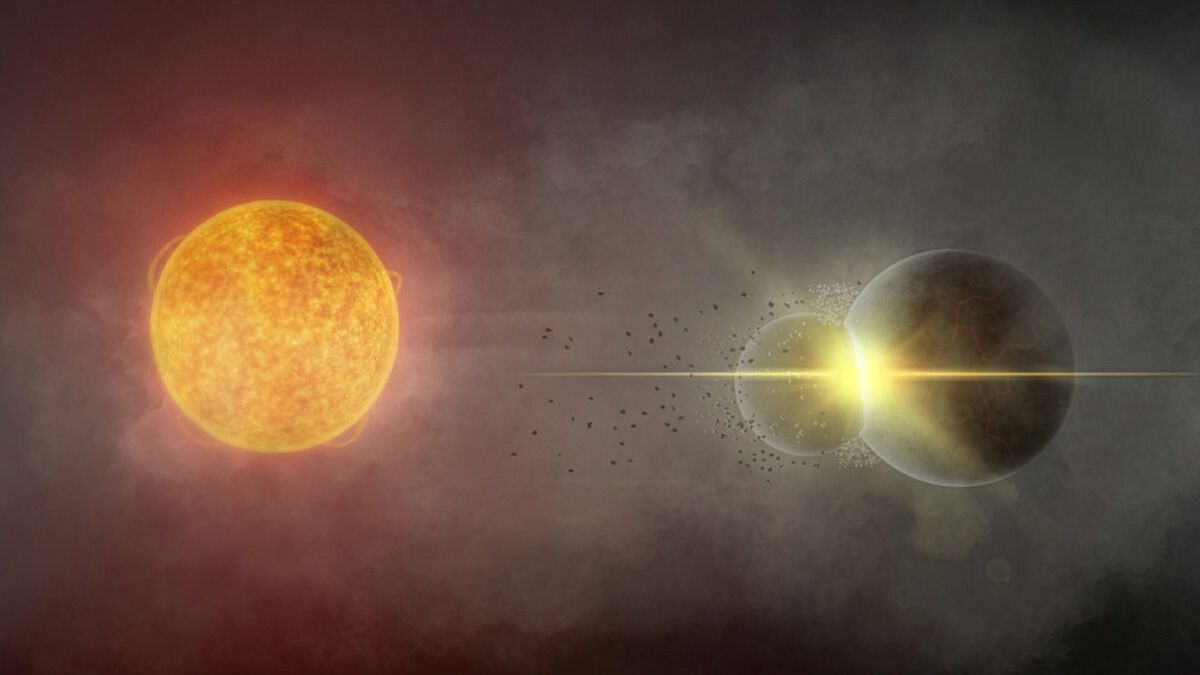
A research team from Caltech may have identified the universe’s first-ever superkilonova, a rare cosmic event where a star explodes in two distinct phases. This groundbreaking discovery follows the detection of gravitational waves on August 18, 2025, which prompted astronomers to investigate the source of this extraordinary occurrence.
The phenomenon known as a supernova occurs when a rapidly spinning star, significantly more massive than the Sun, collapses and detonates, often leaving behind a neutron star. Conversely, a kilonova results from the merger of two neutron stars, which typically originates from a binary system. These cataclysmic events send ripples of gravitational waves through spacetime, akin to a bell ringing in the fabric of the universe.
When gravitational waves were detected by the LIGO-Virgo-KAGRA collaboration, astronomers began a worldwide search for the source. Within hours, they identified a rapidly fading object, designated AT2025ulz, located approximately 1.3 billion light-years away. This event shared similarities with the only previously confirmed kilonova, GW170817, discovered in 2017, which marked a significant breakthrough in pinpointing the origins of gravitational waves.
The discovery of AT2025ulz revealed a red glow resulting from the formation of heavy elements, such as gold, indicating a high-energy collision had occurred. However, after a few days, this red glow was followed by a brightening of the object, which exhibited hydrogen in its spectra, a characteristic typical of a supernova rather than a kilonova. This led researchers to propose that AT2025ulz may represent both phenomena.
Researchers suggest that supernovae could potentially eject two neutron stars from their rapidly spinning debris discs, rather than just one. If these neutron stars were to collide immediately, they might generate the gravitational-wave signal associated with a kilonova. Typically, these mergers occur in open space, providing a clear view of their emissions.
According to Brian Metzger, an astronomer at Columbia University and co-author of the study, the unique aspect of this event is that the merger transpired “within the exploding star, so any kilonova signal would be blocked by the much greater mass ejected from the exploding star.”
Adding to the intrigue, the colliding objects involved in the kilonova included an unexpectedly small body. David Reitze, a laser physicist at LIGO and co-author of the study, noted that “at least one of the colliding objects is less massive than a typical neutron star.” This finding presents a rare opportunity, as the formation mechanisms behind such sub-stellar neutron stars remain a significant challenge in the field of stellar evolution.
Neutron stars typically have a mass between 2.2 and around three solar masses, although they could potentially be as low as 0.1 solar masses. Theoretically, there are two primary ways to create sub-stellar neutron stars from a supernova: through fission, where a rapidly spinning massive star goes supernova and splits into two neutron stars, or through a process called fragmentation. In the fragmentation scenario, a massive star collapses to form a large gas disk that quickly fragments under its own gravity into smaller clumps, which then collapse into low-mass neutron stars.
This discovery serves as a reminder of the universe’s ongoing ability to surprise scientists and emphasize the complexities that can arise from cosmic events. As researchers continue to analyze AT2025ulz and similar occurrences, they stress the need for further investigation to confirm the existence of the superkilonova.
As noted by Mansi Kasliwal, astronomer at Caltech and the study’s lead author, “Future kilonovae events may not look like GW170817 and may be mistaken for supernovae.” The findings of this research are documented in The Astrophysical Journal Letters, further opening the door to a deeper understanding of cosmic phenomena.