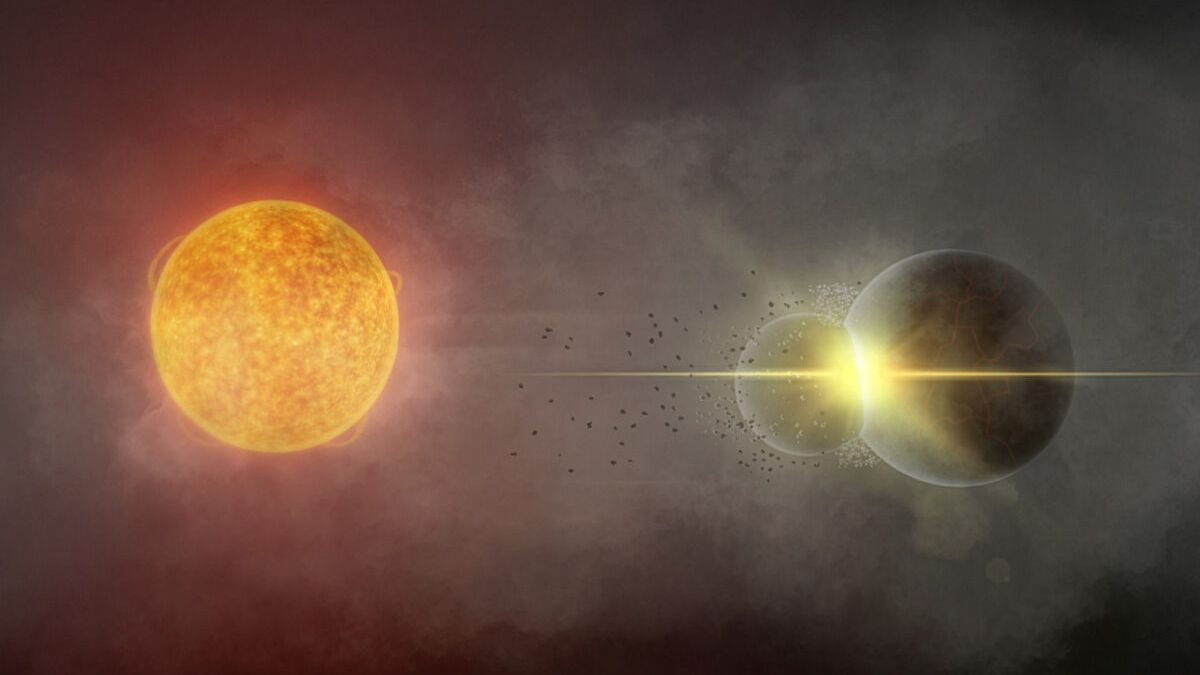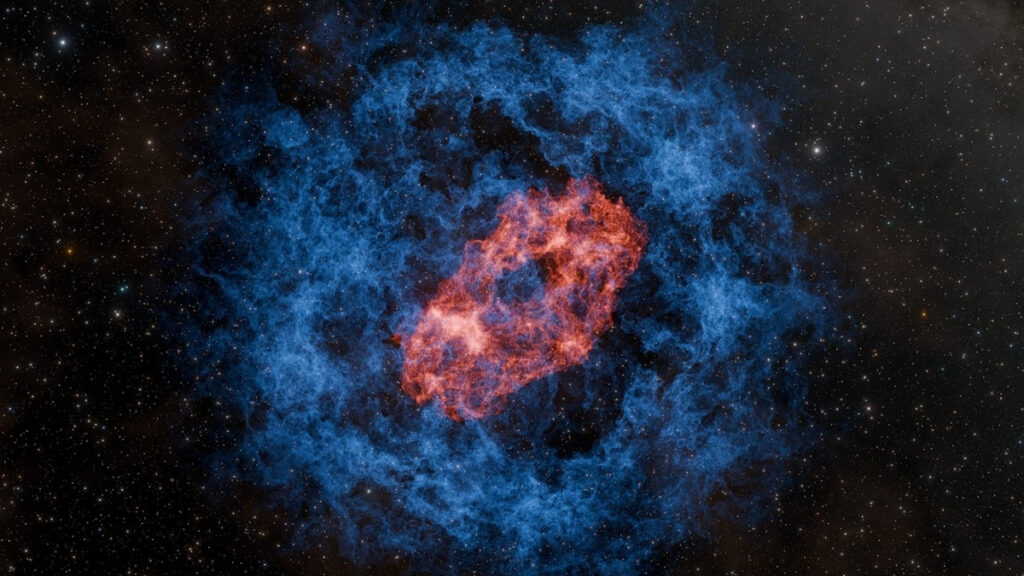
A research team led by Caltech has potentially discovered the first-ever superkilonova, a rare cosmic phenomenon characterized by a star exploding in two distinct ways. This breakthrough stems from a series of observations initiated by gravitational waves detected on August 18, 2025, which may provide evidence of a supernova followed by a kilonova.
Supernovas occur when massive stars, often exceeding the mass of the Sun, collapse and explode, typically leaving behind a neutron star. In contrast, kilonovas arise from the energetic mergers of two neutron stars, which often originate from a binary system. These dramatic events generate gravitational waves that ripple through spacetime, creating detectable signals for astronomers.
After the detection of gravitational waves by the LIGO-Virgo-KAGRA collaboration, astronomers swiftly searched the skies for the source. They located an intriguing and rapidly fading object, designated AT2025ulz, approximately 1.3 billion light-years from Earth. This event bears similarities to the previously confirmed kilonova, GW170817, discovered in 2017, which marked a significant milestone in gravitational wave astronomy.
Both AT2025ulz and GW170817 exhibited signs of heavy element production, such as gold, indicating an energetic collision. Yet, after the initial red glow of AT2025ulz faded, the object brightened again, revealing hydrogen in its spectrum, a characteristic typical of supernovae. This raised the question: what exactly was AT2025ulz—a supernova or a kilonova?
Researchers propose that this event could be both. Previous studies have suggested that supernovae might occasionally produce two neutron stars from their rapidly spinning debris, instead of just one. If these neutron stars were to collide immediately, they could generate the gravitational-wave signal characteristic of a kilonova.
Brian Metzger, an astronomer at Columbia University and a co-author of the study, explained that this merger occurred “within the exploding star,” which may have obstructed any potential kilonova signals due to the more substantial mass ejected from the explosion.
Adding another layer of complexity, the merger involved a surprisingly small object. David Reitze, a laser physicist at LIGO and another co-author, noted that “at least one of the colliding objects is less massive than a typical neutron star.” This finding is significant as the formation mechanisms behind such sub-stellar neutron stars remain a major challenge in understanding stellar evolution.
Neutron stars are generally believed to have a mass limit between 2.2 and 3 solar masses, although they could theoretically be as light as 0.1 solar masses. There are two primary ways to form sub-stellar neutron stars from a supernova: through fission, where a rapidly spinning massive star splits into two neutron stars, or via fragmentation. The latter involves a massive star collapsing into a spinning gas disk, which then fragments into smaller clumps that collapse into low-mass neutron stars.
Metzger likens this process to how planets form in the disks surrounding proto-stars, illustrating the complexity of stellar evolution. The findings surrounding AT2025ulz serve as a reminder of the Universe’s capacity to surprise scientists with its intricate phenomena.
Further research is essential to confirm the existence of superkilonovas and to understand similar cosmic events. Mansi Kasliwal, an astronomer at Caltech and the first author of the study, emphasized that “future kilonovae events may not look like GW170817 and may be mistaken for supernovae.”
This groundbreaking research is detailed in The Astrophysical Journal Letters and highlights the need for ongoing exploration into the enigmatic processes governing the cosmos.