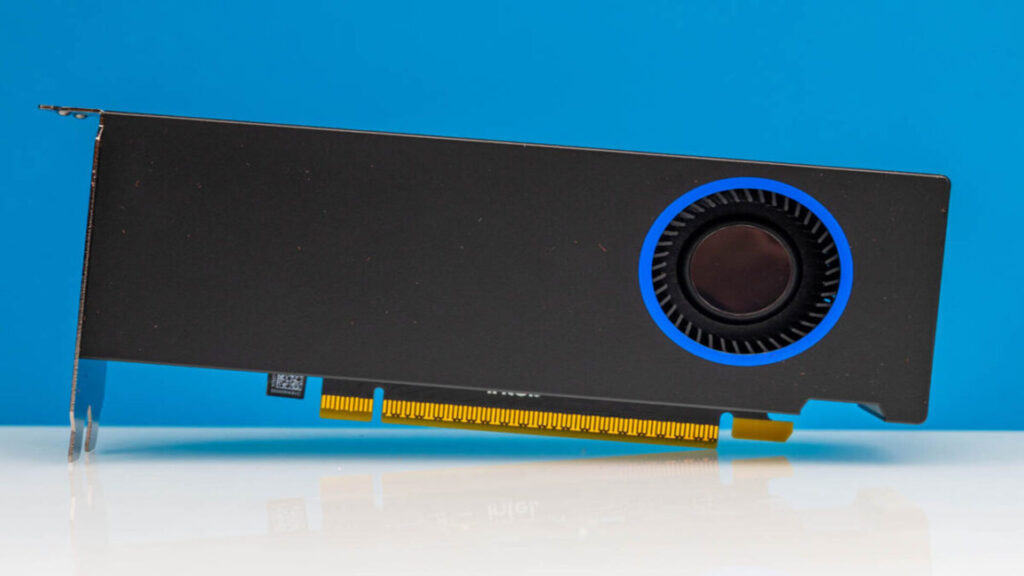
The professional graphics processing unit (GPU) market has seen significant changes in 2025, with the introduction of Intel’s new B50 video card. Priced at approximately $300, the B50 has emerged as a surprisingly effective option for professionals on a budget, despite not matching the performance of higher-end models like Nvidia’s Blackwell series.
Intel’s B50 video card offers commendable performance for entry-level workflows. It competes effectively in tasks such as AI first-token generation, where its times are comparable to those of the 4000 Blackwell series. Although it does not rival high-end GPUs in raw power, its capabilities make it relevant for specific professional applications.
Performance and Benchmark Insights
In synthetic benchmarks, the Intel B50 demonstrates impressive efficiency in MLPerf tests, achieving performance levels akin to the 2000 Blackwell and Radeon W7600. This positions the B50 as a viable choice for lighter machine learning workloads. Its performance in Blender’s rendering tests shows that while it trails behind more powerful GPUs, it can still handle 3D scenes adequately, making it suitable for entry-level 3D work.
For real-time rendering engines like Unreal and Unigine, the B50 generates playable frame rates that cater to basic visualization and preview tasks. While mid-tier Ada and Blackwell GPUs outperform it, the B50 still provides satisfactory results for users with less demanding requirements.
In media editing, the B50 enhances workflows in applications such as After Effects and handles timelines in DaVinci Resolve without significant issues. While GPU-intensive 3D effects reveal its limitations compared to more powerful graphics cards, the B50 maintains a functional performance level for creative tasks. Its steady performance in Topaz Video AI applications allows for consistent scene completion, although CPU usage may impact certain AI-assisted tasks.
Market Positioning and Target Audience
The introduction of Intel’s B50 fills an interesting niche within the professional GPU landscape. While it cannot compete with high-end Blackwell or AMD’s advanced GPUs for sustained AI workloads or offline rendering, its affordability and low power consumption make it attractive for entry-level content creators and users with compact PC setups.
As more professionals seek cost-effective solutions, the Intel B50 stands out as a practical option for those who require modest acceleration without incurring high expenditures on multi-thousand-dollar hardware. For budget-conscious users or those operating in space-constrained environments, the B50 offers an efficient alternative capable of managing lighter professional workloads effectively.
In summary, the Intel B50 video card’s performance, accessibility, and affordability make it a noteworthy player in the professional GPU market, particularly for users who prioritize value in their tech investments. As the landscape continues to evolve, Intel’s entry with the B50 could influence purchasing decisions among professionals looking for reliable solutions without breaking the bank.