




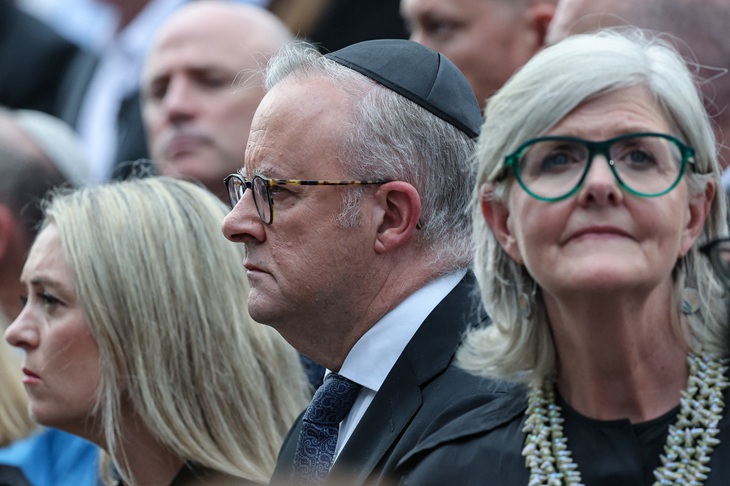
Australia's Prime Minister Anthony Albanese (C), his wife Jodie Haydon (L) and Australia's Governor General Sam Mostyn (R) attend the memorial held for the victims of a shooting at Bondi Beach in Sydney on December 21, 2025. A father and his son are accused of spraying bullets into the family-thronged Hanukkah celebration at Sydney's most famous beach on December 14, allegedly inspired by "Islamic State ideology". (Photo by DAVID GRAY / AFP via Getty Images)
UPDATE: The aftermath of the Bondi shootings has ignited a fierce political firestorm, with calls for accountability reaching a boiling point. As public outrage grows, critics are accusing political figures of exploiting this national tragedy for personal gain.
Just hours ago, prominent figures such as ex-Prime Minister John Howard and ex-treasurer Josh Frydenberg faced backlash for their sharp critiques of current Prime Minister Anthony Albanese. Pollster Kos Samaras described their actions on social media as “politicians treating a national wound like a campaign opportunity.” This sentiment reflects a broader frustration among Australians, who seek unity in the face of tragedy rather than divisive politics.
The Bondi shootings, which occurred recently, have left the nation grappling with grief and confusion. Many citizens are demanding that leaders step up and foster a sense of community resilience. Chris Minns, the NSW State Premier, has called for a Royal Commission into the incident, urging the government to confront the critical issues surrounding public safety and communal healing.
In a time when Australians are reeling from this shocking event, the expectations of leaders are higher than ever. Citizens want assurance that their leaders will not only mourn but also actively work to prevent such tragedies in the future. The dual role of leader as mourner and reassurer is essential for restoring public confidence.
However, the political landscape is increasingly polarized. Figures like Sussan Ley and Andrew Hastie have come under scrutiny for their perceived opportunism, questioning Albanese’s handling of the crisis rather than focusing on collaborative solutions. Critics argue that this behavior undermines the collective healing process that is so vital in these moments of national grief.
Amidst growing tensions, the Prime Minister’s response has been met with skepticism. Many citizens are asking, “What is being done to ensure safety and prevent future incidents?” The perceived lack of a decisive and transparent action plan has left a vacuum that politicians are eager to fill with their own agendas.
As Australia grapples with the implications of the Bondi shootings, the need for genuine bipartisanship is clear. Past experiences have shown that effective governance requires collaboration, especially in crises. The failure of leaders to unify in the face of such an urgent issue raises questions about the political climate and its impact on public trust.
What happens next? As the nation watches closely, the public’s demand for accountability will only intensify. Leaders are urged to move beyond mere political posturing and engage in authentic dialogue regarding public safety and community support. The outcome of the proposed Royal Commission and its findings will be pivotal in shaping the future of Australian politics and societal cohesion.
As the situation develops, citizens are encouraged to remain vigilant and hold their leaders accountable. The Bondi tragedy presents not only a moment of mourning but also an opportunity for profound change within the political landscape of Australia.
