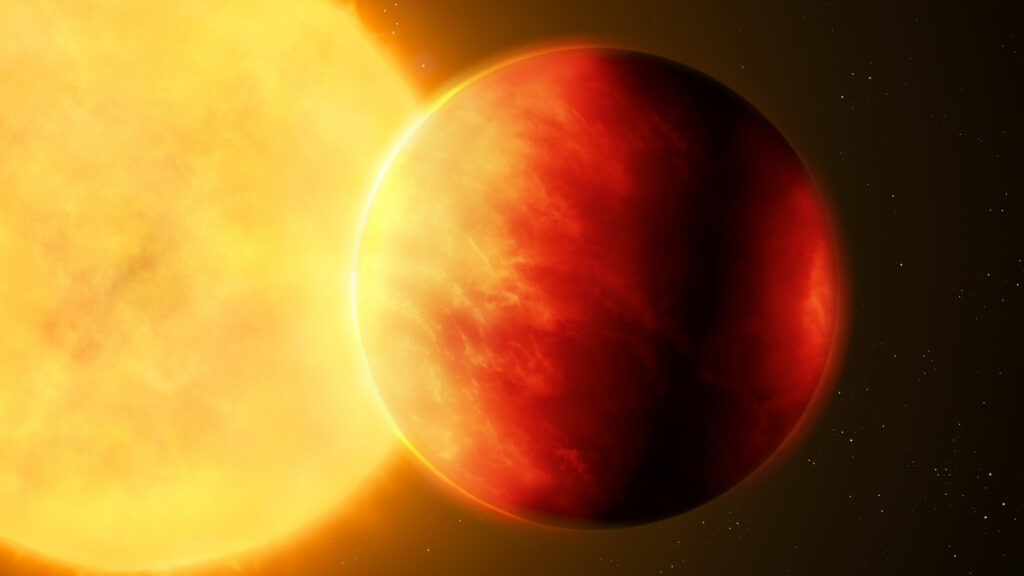
A new study led by researchers at Carnegie Science has unveiled intriguing details about the exoplanet TOI-561 b, which appears to possess a thick atmosphere despite its extreme conditions. This ultra-hot super-Earth features a global magma ocean beneath a dense envelope of volatile chemicals, marking it as a significant find in the search for rocky exoplanets outside our Solar System. The findings were published in The Astrophysical Journal Letters.
Located less than 1.6 million kilometers (approximately 0.99 million miles) from its star, TOI-561 b orbits at a distance just one-fortieth that between the Sun and Mercury. This proximity results in a tidally locked environment, with one side perpetually exposed to sunlight while the other remains shrouded in darkness. Remarkably, TOI-561 b has retained its atmosphere for billions of years, defying expectations that such intense stellar irradiation would strip away gaseous layers from similar planets.
According to Nicole Wallack, an astronomer at Carnegie Science, “Based on what we know about other systems, astronomers would have predicted that a planet like this is too small and hot to retain its own atmosphere for long after formation.” TOI-561 b is categorized as an ultra-short period (USP) planet, completing its orbit in under 11 hours. With a mass approximately twice that of Earth and a radius 1.4 times larger, its characteristics pose significant questions about planetary formation and retention of atmospheres.
The host star of TOI-561 b is believed to be around 10 billion years old, more than twice the age of our Sun. This elderly star is less massive and cooler than the Sun, enriched with alpha elements like oxygen and magnesium, which were produced by massive stars in the early Universe. Its low iron content suggests an ancient environment, contributing to the uniqueness of TOI-561 b.
One of the most surprising aspects of TOI-561 b is its low density, roughly four times denser than water. This could indicate a composition of less dense rocks than those found on Earth, or it may suggest that the planet’s atmosphere is contributing to its apparent size. Researchers employed data from the James Webb Space Telescope (JWST), which monitored the planet’s system for over 37 hours, to investigate this further.
Through measurements of TOI-561 b’s dayside brightness in near-infrared light using Webb’s NIRSpec (Near-Infrared Spectrograph), researchers calculated its temperature. Without an atmosphere, the planet would likely reach temperatures around 2,700 degrees Celsius (approximately 4,900 degrees Fahrenheit). However, the data indicated a significantly cooler temperature of approximately 1,800 degrees Celsius.
The research team proposed that TOI-561 b’s atmosphere might be responsible for this cooling effect. It is hypothesized that atmospheric winds could transport heat from the dayside to the nightside, while water vapor might absorb near-infrared light, further contributing to the lower surface temperature. Understanding how TOI-561 b has maintained its thick atmosphere in such extreme conditions is a central question for researchers.
The team suggests that the exoplanet could have reached a balance between its atmosphere and the surface-covering magma ocean. Gases may have seeped from the planet’s crust to sustain the atmosphere, while the magma ocean could act as a reservoir, drawing some gases back into the interior. The planet’s iron content could also play a crucial role, possibly helping to trap volatile chemicals within its magma ocean or core.
The researchers noted, “From the sample of rocky planets with dayside brightness temperature constraints, it appears that planets with irradiation temperatures exceeding 2000 K are able to replenish volatile envelopes faster than they are lost.” They emphasized that pinpointing the specific reasons behind TOI-561 b’s thick atmosphere will require further theoretical and observational work.
As the understanding of exoplanets continues to evolve, TOI-561 b stands out as a compelling case that challenges existing models of planetary atmospheres in extreme environments.