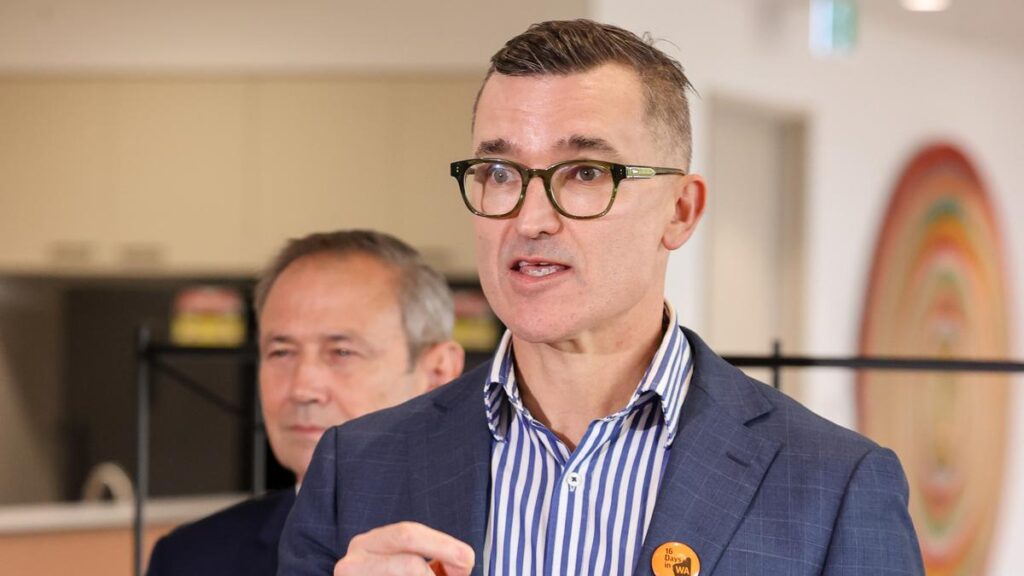
Housing Minister John Carey speaks to the media at East Perth Common Ground on Monday.
The housing crisis in Western Australia is escalating, with more than 23,000 people now on the public housing waitlist. This figure, a stark increase of 5,000 since the Labor government secured its second term in 2021, highlights a growing struggle for many residents to secure stable accommodation as they face rising costs and limited options.
Recent data revealed that the average wait time for public housing has reached 165 weeks, translating to over three years. This is a notable rise from 152 weeks reported last year. The priority waitlist has also seen alarming growth, jumping from 3,716 in 2021 to 7,934 this year, with an average wait time of 99 weeks for priority applicants.
According to the office of Housing Minister John Carey, the public housing waitlist reflects broader economic challenges. Despite Western Australia’s forecasted $18 billion in resources royalties and GST payments this year, many residents are not experiencing the benefits of this wealth. The situation is compounded by high rental prices, with the average weekly rent in Perth now at $700.
Carey defended the government’s efforts to address the housing shortage, stating, “The State Government is doing everything it can to bolster the supply of housing throughout Western Australia with a record investment of $5.1 billion in housing and homelessness.” He noted that more than 3,000 social homes have been added to existing stocks since 2021.
As the waitlist grows, the number of families struggling to pay their utility bills has also surged. Synergy, the state’s energy provider, reported that 32,043 families and 10,108 businesses are currently on payment plans due to financial difficulties, accumulating a total debt of $127.7 million.
Lesley Walker, executive general manager of customer services at Synergy, emphasized the company’s commitment to supporting those in financial hardship. “We want to support customers and work with them so they can access assistance that suits their circumstances,” she explained. “We offer payment plans and other assistance to help customers facing financial hardship.”
The use of debt collection has become a last resort for Synergy, with approximately 10,000 residential customers and 804 business customers referred to collection agencies. Walker reassured the public that disconnections for those facing financial hardships are avoided if they engage with the company for assistance.
The lengthy wait times for social housing can be attributed to various factors, including applicants declining offered properties, the need for specific housing features, and changes in personal circumstances. Carey acknowledged these challenges, adding that the demand for social housing is increasing as more individuals seek the security it offers amid rising private market pressures.
The situation in Western Australia serves as a reminder of the complexities surrounding housing access and affordability, as thousands of residents navigate the difficult landscape of both housing and utility costs. As the government continues to invest in solutions, the impact on individuals and families will be closely monitored in the coming years.