




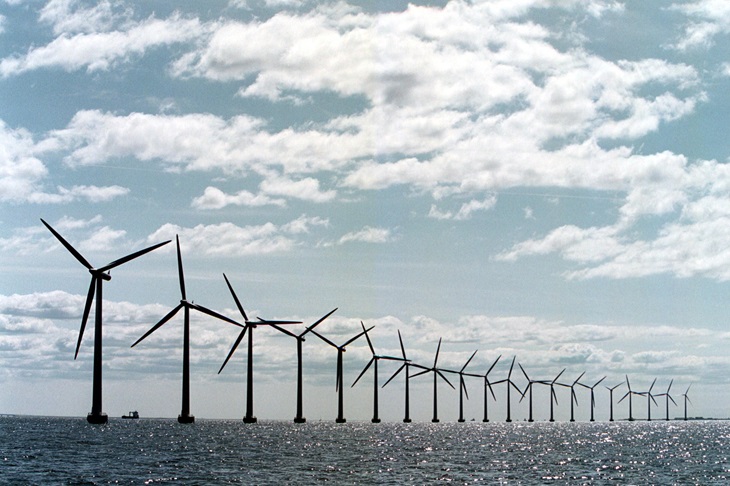
(FILES) - A picture taken 06 May 2001 shows the world's largest offshore wind farm, Middelgrunden Windmill Farm, located in the Oeresund, three km from Copenhagen harbour. French companies EDF and Alstom secured the tender to install hundreds of offshore wind turbines along the french coast, on April 6, 2012. AFP PHOTO FILES SCANPIX SOEREN BIDSTRUP (Photo credit should read SOEREN BIDSTRUP/AFP via Getty Images)
UPDATE: Major shifts are underway in the offshore wind sector as national security concerns come to the forefront, triggering immediate market reactions. Just today, shares of Ørsted, the world’s largest offshore wind developer, plummeted by more than 14 percent, resulting in billions lost in market value. This alarming financial decline signals a significant reassessment of offshore wind projects amid escalating security threats.
Authorities in Sweden and Germany are sounding alarms over potential risks associated with offshore wind infrastructure. Military and intelligence agencies have raised issues regarding interference with radar systems and naval operations, leading to Sweden canceling 13 offshore wind projects due to unacceptable risks. Concerns have also been voiced regarding the presence of Chinese-manufactured turbines near NATO waters, amplifying security scrutiny.
Cybersecurity experts warn that the reliance on highly digitized and remotely monitored offshore wind farms makes them vulnerable to cyber-attacks. Industry analysts stress that disruptions could have catastrophic effects on critical infrastructures, affecting ports, power grids, and maritime operations simultaneously.
Despite these escalating concerns, the Australian federal government is pressing forward with offshore wind initiatives in states like Victoria, Tasmania, Western Australia, and along the Illawarra and Hunter coastlines. This decision places Australia at odds with key allies that are now pausing to reassess the risks associated with such projects.
The implications of this decision are particularly pronounced along the New South Wales coastline, where proposed offshore wind zones intersect with critical infrastructure at Port Kembla and the Port of Newcastle. Port Kembla is vital not only for Australia’s largest steelworks but also for its crucial grain export terminal, impacting national food security. Additionally, it is the planned site for a gas import terminal that is expected to meet nearly all of New South Wales’ gas needs.
Similarly, the Port of Newcastle serves as Australia’s largest coal export hub, essential for the nation’s export revenue and energy markets. The geographical significance of these ports cannot be overstated; any disruption due to offshore wind installations poses serious risks to national security.
Former Shadow Defence Minister Andrew Hastie has formally raised concerns regarding the offshore wind proposals affecting Australia’s sovereignty and national security. In a recent parliamentary submission, he emphasized the need for thorough consideration of the geopolitical implications, urging consultations with Australia’s Aukus partners, the United States and United Kingdom.
Hastie warned that Australia must learn from Europe’s recent energy crises, stating, “We would be foolish not to heed it, and risk the lights going out in a strategic crisis.”
The urgent question now is whether Australia will pause to evaluate these critical concerns or proceed without caution. As other nations reconsider their offshore wind strategies, the financial markets are already reacting to this shift, underscoring the need for a balanced approach that integrates energy policy with national security considerations.
The lesson learned from international counterparts is clear: offshore wind development cannot be viewed through an isolated lens. The interplay of location, supply chain integrity, cybersecurity, and defense must guide future projects.
As the situation develops, the potential for offshore wind to contribute to Australia’s energy mix remains, but it must align with broader security frameworks. The stakes have never been higher, and the national discourse surrounding offshore wind is rapidly evolving into a matter of urgent national interest.
Stay tuned for more updates as this story unfolds.
