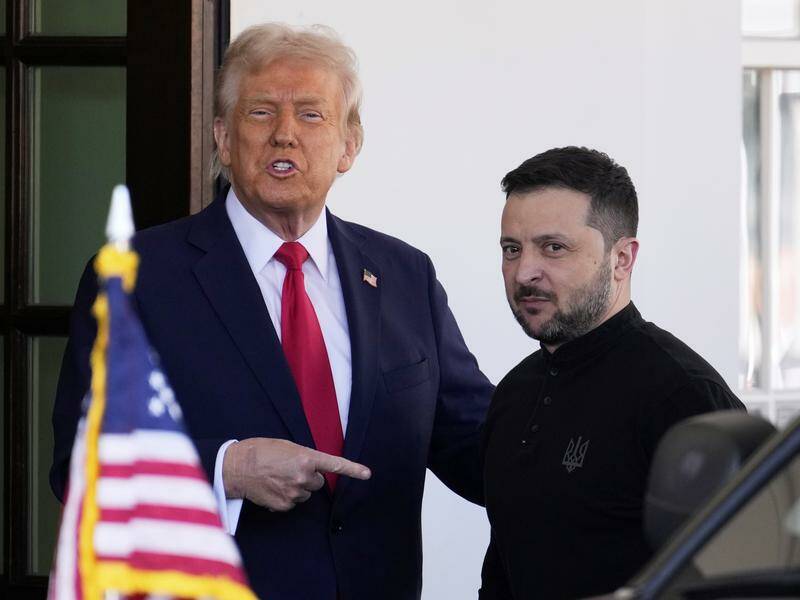
Ukrainian President Volodymyr Zelenskiy and former United States President Donald Trump are preparing for critical discussions in Florida aimed at finding a resolution to the ongoing conflict in Ukraine. The meeting, scheduled for Sunday, follows a series of Russian air attacks that have intensified tensions, underscoring the complexities surrounding peace negotiations.
On Saturday, local time, Russia launched a barrage of missiles and drones targeting Kyiv and other regions of Ukraine, resulting in power outages and heating disruptions in parts of the capital. Zelenskiy characterized these attacks as a clear response to ongoing peace efforts facilitated by the United States.
During the upcoming meeting, Zelenskiy plans to address several key issues, including the future of the contested Donbas region and the status of the Zaporizhzhia nuclear power plant. Russian authorities have consistently demanded that Ukraine cede control of all areas within Donbas, which complicates the dialogue and raises questions about the willingness of Russian President Vladimir Putin to accept any agreements reached during the talks.
Zelenskiy expressed a desire to negotiate modifications to a recent U.S. proposal, which suggests a complete withdrawal of Ukrainian forces from Donbas. He indicated that, if necessary, the entire 20-point plan resulting from extensive negotiations could be subjected to a referendum vote. According to Axios, U.S. officials view this willingness to consider a referendum as a significant development, suggesting that Zelenskiy might be open to territorial concessions. Nevertheless, he stipulated that Russia must agree to a 60-day ceasefire to facilitate preparations for such a vote.
Recent polling indicates that Ukrainian voters may not support the proposed plan, further adding to the uncertainty surrounding the talks. Zelenskiy’s in-person meeting with Trump is set for 1 PM local time (5 AM Monday AEDT) and follows weeks of diplomatic maneuvering.
Russia currently controls all of Crimea, which it annexed in 2014, and since the onset of the war nearly four years ago, has occupied approximately 12% of Ukrainian territory. This includes about 90% of Donbas and significant portions of the Zaporizhzhia and Kherson regions. According to Russian estimates, this territorial expansion has included advances into parts of Kharkiv, Sumy, Mykolaiv, and Dnipropetrovsk.
On December 19, 2024, Putin articulated that any peace agreement would require Ukraine to withdraw from Donbas, Zaporizhzhia, and Kherson, while also formally renouncing its aspirations to join NATO. Zelenskiy remarked after his arrival in Halifax, Nova Scotia, that the recent airstrikes illustrate Putin’s lack of interest in achieving peace.
During a brief statement with Zelenskiy, Canadian Prime Minister Mark Carney emphasized that lasting peace “requires a willing Russia,” in light of the overnight attacks on Kyiv. Carney announced a commitment of $CAD2.5 billion (approximately $A2.73 billion) in additional economic aid to Ukraine, reinforcing international support for the country during this challenging period.
European Commission President Ursula von der Leyen also engaged with Zelenskiy and other European leaders on the same day, reaffirming their collective aim for “a just and lasting peace” that preserves Ukraine’s sovereignty and strengthens its defense capabilities. Following his meeting with Trump, Zelenskiy plans to continue discussions with European leaders to further coordinate efforts for peace and recovery.