A new theoretical paper suggests that the masses of fundamental particles, such as the Z and W bosons, may originate from the twisted geometry of hidden dimensions. Researchers propose a model that could bypass the conventional understanding of the Higgs field as the source of particle masses. This work not only offers fresh insights into the Higgs mechanism but also addresses some unresolved issues within the Standard Model of particle physics.
According to theoretical physicist Richard Pinčák from the Slovak Academy of Sciences, “In our picture, matter emerges from the resistance of geometry itself, not from an external field.” The Higgs field was initially proposed in the 1960s to resolve the question of why certain particles possess mass, a significant challenge that had hindered the development of a cohesive particle physics model. It is through the Higgs mechanism that physicists can explain why particles interact with this invisible field differently, resulting in varied masses.
To illustrate, envision the Universe filled with an invisible, sticky substance. Particles moving through this medium experience different levels of interaction; those that interact strongly, like W and Z bosons, are perceived as heavy, while others, like electrons, are considered light. Photons, notably, do not interact with the Higgs field at all. The discovery of the Higgs boson at the Large Hadron Collider in 2012 confirmed the field’s existence, yet significant questions remain unanswered.
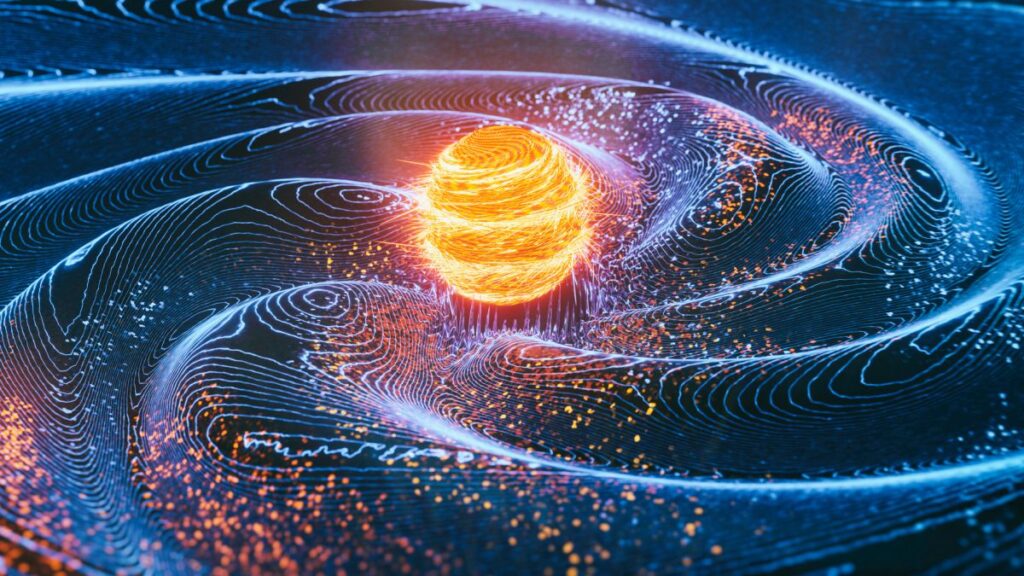
The new research delves into a theoretical framework involving a seven-dimensional space known as a G2 manifold, which is used to explore the geometry of these hidden dimensions. Manifolds are mathematical spaces that can exhibit curves and twists, and physicists often apply them to describe complex geometries in theoretical physics, including those suggested by string theory.
Pinčák and his team introduced an equation called the G2-Ricci flow, which models the evolution of a G2 manifold over time. He explains, “As in organic systems, such as the twisting of DNA or the handedness of amino acids, these extra-dimensional structures can possess torsion, a kind of intrinsic twist.” This evolving geometry can settle into stable configurations known as solitons, which may provide geometric explanations for complex phenomena like spontaneous symmetry breaking.
The researchers found that their G2 manifold could relax into a stable structure with a torsion that mirrors the mass-generating effect attributed to the Higgs mechanism. Interestingly, they also speculate that the accelerating expansion of the Universe could be related to the curvature induced by torsion in a G2 manifold. If this torsion operates as a field, it could yield particles similar to how the Higgs field generates the Higgs boson.
The team has proposed a hypothetical particle named the Torstone, which they believe could be detected through anomalies in particle collider data, irregularities in the cosmic microwave background, or even fluctuations in gravitational waves. While the existence of the Torstone is not yet established, the research identifies potential avenues for further exploration.
Pinčák reflects on the implications of their findings, stating, “Nature often prefers simple solutions. Perhaps the masses of the W and Z bosons come not from the famous Higgs field, but directly from the geometry of seven-dimensional space.” This research has been published in the journal Nuclear Physics B, paving the way for new discussions in the field of particle physics.
As researchers continue to unravel the complexities of the Universe, this theoretical model presents an exciting opportunity to deepen our understanding of fundamental forces and particles.