




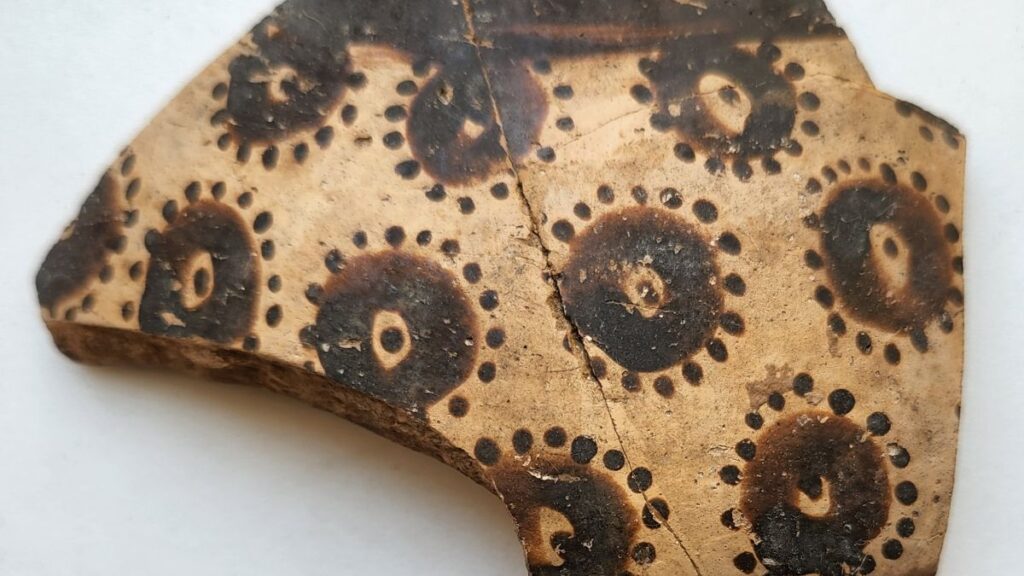
UPDATE: A groundbreaking study reveals that the world’s oldest known botanical art, originating from the Halafian culture in northern Mesopotamia around 6000 BCE, demonstrates an early form of mathematical thinking. This research, just published in the Journal of World Prehistory, uncovers a fascinating intersection of art and mathematics that could reshape our understanding of ancient cognitive development.
The study, led by archaeologists Yosef Garfinkel and Sarah Krulwich from the Hebrew University of Jerusalem, indicates that decorated pottery from this era not only highlights an appreciation for the beauty of plants but also showcases sophisticated numerical patterns in its motifs. These findings suggest that early humans engaged in mathematical reasoning long before the advent of written numerical symbols.
Garfield and Krulwich meticulously analyzed plant motifs from pottery excavated at 29 archaeological sites, revealing that many of these motifs—flowers, seedlings, and trees—were not related to agriculture, but rather stemmed from an aesthetic appreciation of plant beauty. “These vessels represent the first moment in history when people chose to portray the botanical world as a subject worthy of artistic attention,” the researchers assert, highlighting a significant cognitive shift linked to the rise of village life.
Crucially, the study emphasizes that the floral designs reflect a keen sense of symmetry and balance, likely rooted in practical aspects of daily life, such as sharing resources and managing communal fields. The researchers noted that the plants depicted are evenly distributed across the pottery, often arranged in strict sequences.
Most strikingly, many pottery pieces feature floral motifs where the number of petals follows geometric sequences: 4, 8, 16, 32, and even 64 petals. This deliberate progression underscores an advanced level of mathematical reasoning. “These patterns show that mathematical thinking began long before writing,” Krulwich explains, suggesting that ancient communities visualized divisions and sequences through their art.
This discovery not only sheds light on the cognitive capabilities of ancient cultures but also invites us to reconsider the origins of mathematical thought. The implications of this research extend beyond archaeology; it offers a glimpse into the intellectual lives of our ancestors, who were capable of complex thought and expression through artistic mediums.
As this research gains attention, it opens the door for further exploration into how early humans understood and interacted with their environment. The findings are likely to spark discussions among historians, mathematicians, and artists alike, emphasizing the interconnectedness of art and science in human history.
Stay tuned for more updates as this story develops and as experts continue to analyze the profound impacts of ancient art on modern understanding of mathematics and cognition.
