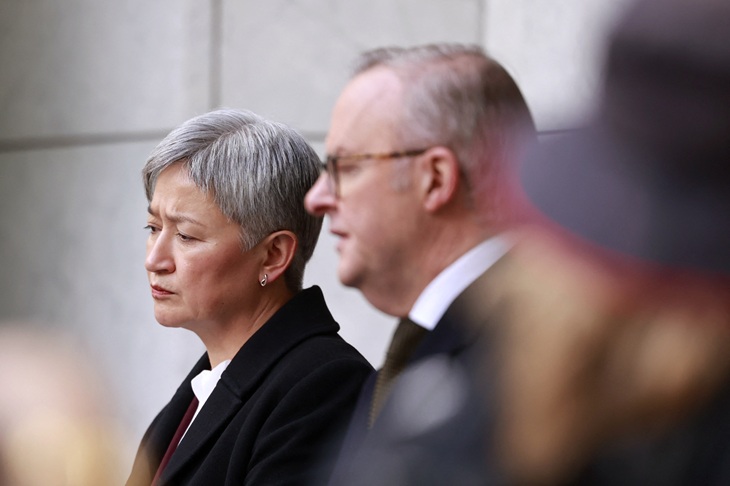
Australia's Foreign Minister Penny Wong (L) listens to Australia's Prime Minister Anthony Albanese as he speaks during a press conference in Canberra on August 11, 2025. Australia will recognise a Palestinian state at the UN General Assembly in September, Prime Minister Anthony Albanese said on August 11. (Photo by Hilary Wardhaugh / AFP) (Photo by HILARY WARDHAUGH/AFP via Getty Images)
In response to the recent terrorist attack at Bondi Beach, victims’ families and Jewish organizations are urging the Australian government to ensure that violence against Jewish Australians is not normalized. This has sparked calls for a federal Royal Commission to investigate what many believe are systemic failures that contributed to the attack. Critics, however, argue that such an inquiry may not address the root causes of antisemitic violence currently prevalent in society.
Many observers contend that the push for a Royal Commission reflects a reluctance to confront the underlying ideologies that have led to increased antisemitic incidents. For over two years, a specific form of antisemitism has gained traction, characterized by a narrative that frames Jews as legitimate targets under the guise of opposing “Zionism.” This modern iteration of antisemitism—often labeled as anti-Israelism—has reshaped public perception, allowing for hostility toward Jews to be justified in moral terms.
The evolution of antisemitic sentiments has historically shifted in response to societal changes. In the past, Jews faced persecution primarily for their religious beliefs, which were seen as a threat to Christian moral order. Accusations of ritual murder and blood libels were common, and such beliefs were propagated through education and religion, leading to widespread violence against Jewish communities.
As society moved away from religious authority, racial theories emerged, depicting Jews as biologically inferior and a threat to national integrity. This form of antisemitism culminated in horrific consequences, including the Holocaust, where six million Jews were murdered during World War II.
Today, the narrative has morphed again. In contemporary discourse, Jews are often accused of violating moral standards through the existence of the Jewish state, Israel. This form of anti-Israelism posits that Jewish self-determination equates to moral wrongdoing, a notion that has gained considerable traction in public discussions since the escalation of violence in Gaza and Israel on October 8, 2023.
Critics argue that these accusations, which include claims of genocide and apartheid, are fundamentally misleading. For instance, Israel is frequently branded as an illegitimate state, yet it operates as a multi-ethnic democracy that grants full civil rights to its Arab and other minority populations. The portrayal of Israel as a perpetrator of ethnic cleansing is challenged by the reality of a growing Palestinian population, which complicates the narrative that frames Jews as aggressors.
Despite the proliferation of these claims in mainstream media, the Australian government has been criticized for failing to challenge them adequately. Instead, some government supporters and unions have seemingly endorsed these narratives, which further entrenches hostility towards Jewish communities.
What complicates the situation is the application of a unique moral standard to Jews. Other nations are not subjected to the same scrutiny or accusations of genocide when defending their sovereignty. This double standard transforms Jewish self-defense into aggression and undermines the legitimacy of Jewish existence as a collective.
The call for a Royal Commission has been met with skepticism. Critics suggest that such an inquiry would likely result in a superficial examination of the issues, channeling public frustration into hearings and reports without addressing the core ideological problems. Australia has conducted over 130 federal Royal Commissions in its history, and none have successfully held the government accountable for its failures.
Instead of instituting a Royal Commission, advocates argue that the Australian government needs to directly confront the false narratives surrounding Israel and antisemitism. This would involve publicly naming inaccurate claims, reevaluating official language, and enforcing existing laws related to hate speech.
Political courage is essential for addressing the ideological challenges that underlie current antisemitic sentiments. Without confronting these narratives head-on, any efforts to address the issue may simply serve as a façade, avoiding the more complex task of dismantling the ideologies that fuel discrimination against Jewish Australians.
As the Jewish community navigates the aftermath of the Bondi Beach attack, the need for genuine engagement with the facts and a commitment to combating antisemitism remains critical.