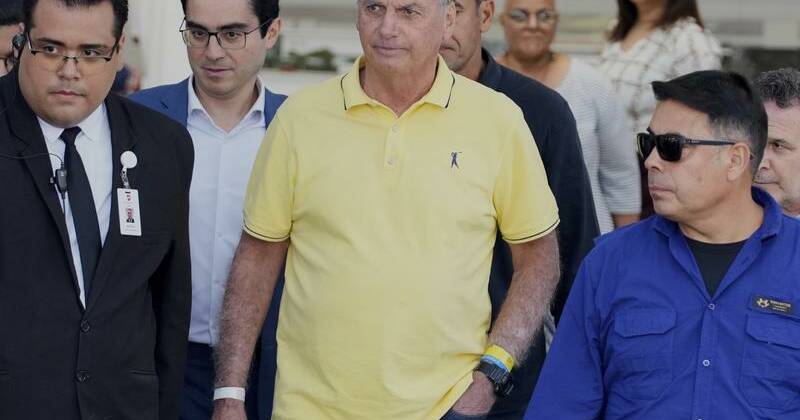
Former Brazilian President Jair Bolsonaro has been released from the hospital and is returning to prison following a court decision that denied his request for house arrest. The 70-year-old politician will go back to the Federal Police Superintendency in Brasilia, where he is serving a sentence of over 27 years for his involvement in a coup plot after losing the 2022 presidential election.
On Thursday, Supreme Court Justice Alexandre de Moraes rejected a plea from Bolsonaro’s legal team to allow him to serve his sentence under “humanitarian house arrest.” This decision comes shortly after Bolsonaro was hospitalized to address chronic hiccups and to undergo surgery for a double hernia. His health issues have been ongoing, notably following a stabbing incident during the 2018 election campaign that left him severely injured.
The court found that Bolsonaro’s actions did not warrant a change in his imprisonment status. Justice de Moraes emphasized that the former president had not demonstrated the legal criteria necessary for house arrest. Key to the ruling was the revelation that Bolsonaro had destroyed an electronic ankle bracelet intended to monitor his movements, which was seen as an apparent attempt to escape.
In the ruling, de Moraes stated, “Contrary to what the defense alleged, Bolsonaro’s health situation did not worsen. On the contrary, his clinical state shows improvement of the problems he had been complaining about after undergoing new elective surgeries, as indicated in the report of his doctors.”
Since leaving office in December 2022, Bolsonaro has faced significant legal challenges. He has been imprisoned since late November 2022 after the Supreme Court determined that he conspired with allies to undermine the government of his successor, Luiz Inácio Lula da Silva. The court’s decision highlights ongoing tensions in Brazilian politics, particularly between supporters and opponents of Bolsonaro.
As Bolsonaro returns to prison, the implications of his legal battles continue to resonate within Brazil’s political landscape, drawing attention to issues of governance and accountability in the aftermath of his presidency.