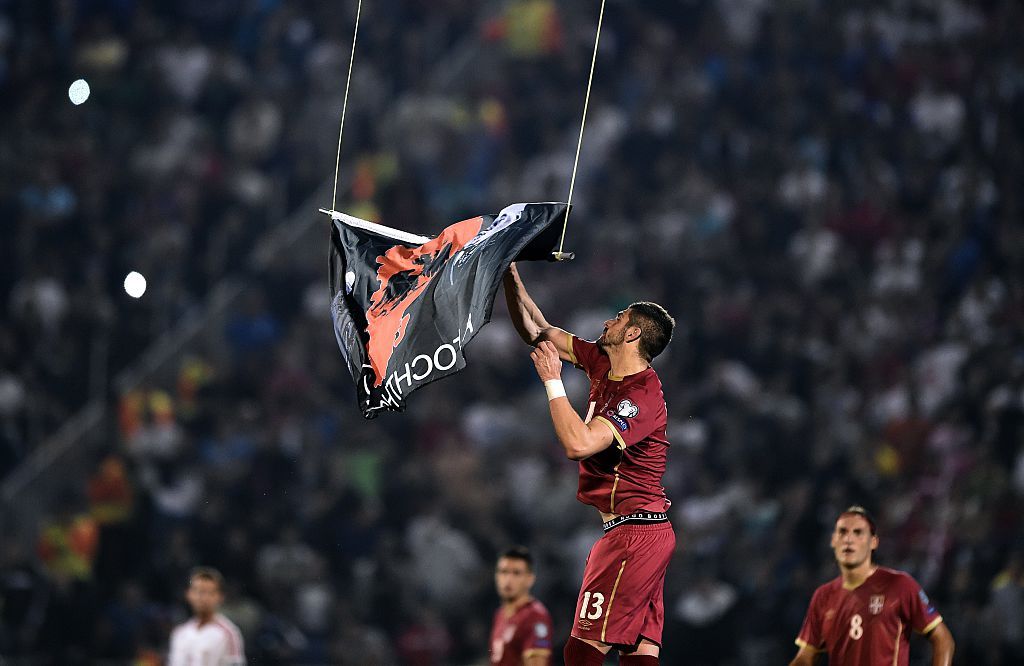
Serbia's Stefan Mitrovic grabs a flag with Albanian national symbols flown by a remotely operated drone during the Euro 2016 group I football match between Serbia and Albania in Belgrade on October 14, 2014. AFP PHOTO / ANDREJ ISAKOVIC (Photo credit should read ANDREJ ISAKOVIC/AFP via Getty Images)
A Euro 2016 qualifying match between Serbia and Albania erupted into chaos on October 14, 2014, when a drone carrying a pro-Albania banner flew over the stadium in Belgrade, leading to the abandonment of the game before half-time. The encounter, marked by political tensions, has become a notable example of how football and national rivalries can intersect dramatically.
Former Serbian midfielder Nemanja Matic, who played in that contentious match, recently reflected on the events that unfolded. “They didn’t come to play football, but to provoke us,” Matic stated in an interview. He emphasized that the Albanian team likely recognized their limited chances on the pitch and resorted to provocations instead.
The match quickly descended into disorder as Serbian fans reacted to the drone. Matic recalled, “Our fans were stupid. They fell for the provocation and jumped on the pitch, then the Albanian team went inside.” Following the chaos, the Albanian Football Federation declared they would not continue the match. Consequently, UEFA awarded Albania a 3-0 victory and penalized Serbia by deducting three points from their qualification campaign.
Reflecting on the aftermath, Matic expressed disappointment with the decision. “We wanted to play; we didn’t want any problems,” he said. The events of that evening remain vivid in his memory, illustrating the broader implications of football in a politically charged environment.
After the controversial match, Serbia and Albania faced off again in June 2015, where Serbia secured a 2-0 victory on Albanian soil. This match served to underline the competitive spirit between the two nations, albeit under far less tumultuous circumstances.
While some argue that the match’s outcome was a fair response to the situation, Matic’s perspective highlights the emotional toll the incident took on the Serbian team. “Someone made that provocation with the drone and knew that Serbian people would explode when they saw it,” he remarked, shedding light on the calculated nature of the incident.
The October 2014 qualifier not only affected the teams involved but also resonated with fans and analysts alike, emphasizing the potential for sporting events to become arenas for political expression. As football continues to serve as a platform for national pride, the interplay between sport and politics remains a significant topic of discussion.
Matic’s experiences and the events of that fateful evening serve as a reminder of the challenges that come with international competition, where sportsmanship can sometimes be overshadowed by deeper national sentiments.