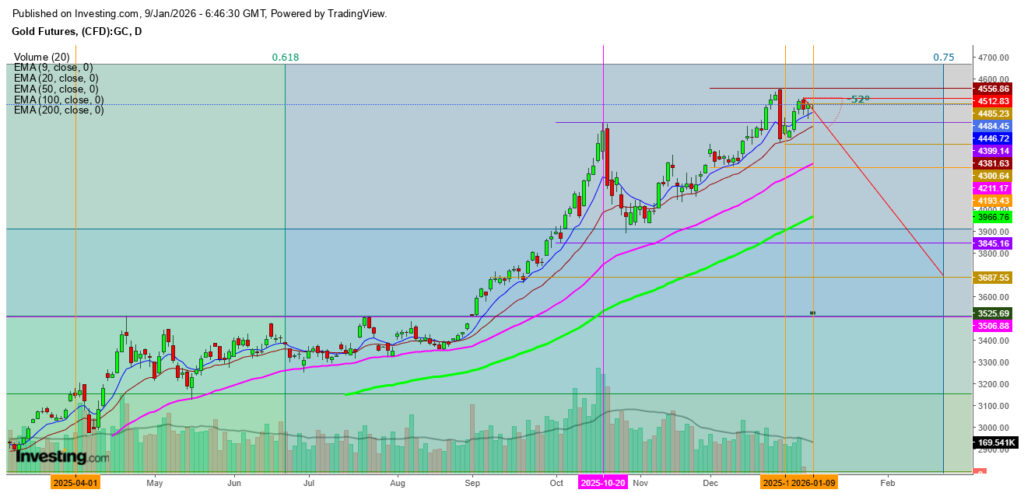
Gold futures are showing signs of potential exhaustion as traders closely monitor upcoming economic data that could influence market movements. Following a peak on December 29, 2025, where prices reached an all-time high, gold futures have since declined, reflecting a notable inverse correlation with the XAU/XAG (Gold/Silver) ratio. This connection suggests that fluctuations in silver prices may offer insights into gold’s trajectory.
After hitting a record high of approximately $4,341 on December 30, 2025, gold futures encountered significant resistance at the nine-day exponential moving average (9 EMA), which was around $4,388. The following days saw further volatility, with prices dipping and then rebounding to a high of $4,507 on January 6, 2026. This fluctuation coincided with the XAU/XAG ratio testing a low of 45.31, indicating market indecision.
As the new year progressed, the XAU/XAG ratio demonstrated a reversal after facing resistance at 59.81. Gold futures, however, remained robust, reaching $4,512 on January 7, 2026, before experiencing a sharp decline. On January 8, 2026, gold futures found some support after a low of $4,420, but a stronger U.S. dollar tempered gains ahead of crucial labor market data expected to be released soon.
The last trading session saw gold futures operating within a narrow range, beginning the day at $4,485.44. During the day, prices peaked at $4,486.80 and dipped to $4,461.94, ultimately closing near $4,475.76. This trading pattern has formed a bearish doji pattern, suggesting potential weakness as futures hover near the previous day’s high.
Given the current market dynamics, the XAU/XAG ratio appears poised for a reversal, indicating that exhaustion may be imminent for gold futures. A breakdown below immediate support at the 9 EMA, currently at $4,446, could push prices down to test the next support level at the 20 EMA around $4,381. Should this level fail, further declines could see futures testing the significant support at the 50 EMA, which is approximately $4,211.
Investors are advised to proceed cautiously, as market conditions remain volatile and influenced by external economic factors. This analysis is based on current observations and does not constitute financial advice. Readers should assess their risk tolerance before making any investment decisions.