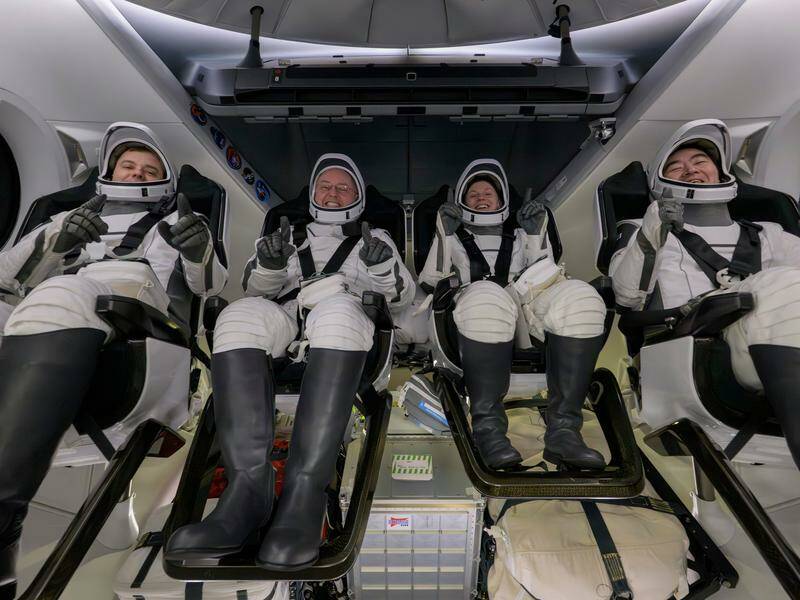
A SpaceX capsule has safely returned a four-member crew to Earth following an emergency descent due to a serious medical condition affecting one astronaut. The Crew Dragon capsule, named Endeavour, splashed down in the Pacific Ocean off the coast of San Diego shortly after midnight on January 8, 2024. This marked a significant event as it was the first instance where NASA has cut short an International Space Station (ISS) mission due to health concerns.
The capsule’s descent lasted over ten hours, beginning with its departure from the ISS and culminating in a fiery re-entry through Earth’s atmosphere. Live video provided by NASA and SpaceX captured the deployment of two sets of parachutes, which slowed the capsule’s descent to approximately 25 km/h before it gently landed on the ocean’s surface.
Upon splashdown, dolphins were seen swimming near the capsule, adding a surreal touch to the return. The spacecraft remained upright, bobbing gently in the water. In a radio communication to the SpaceX flight-control center, Commander Zena Cardman, a NASA astronaut, expressed relief, stating, “It’s good to be home.”
Joining Cardman on this return flight were fellow crew members: Mike Fincke, a veteran astronaut, Kimiya Yui from Japan, and Oleg Platonov from Russia. The crew had originally launched to the ISS from Florida in August 2023 and was expected to complete a 180-day mission. Instead, they concluded their journey after 167 days in space.
The decision to expedite their return was announced on January 8, with NASA Administrator Jared Isaacman confirming that one of the astronauts was facing a serious medical issue that necessitated immediate attention on the ground. The specific details regarding the medical condition of the affected astronaut have not been disclosed due to privacy considerations.
Prior to this medical emergency, Fincke and Cardman were scheduled to conduct a lengthy spacewalk to install new hardware outside the ISS. However, this operation was cancelled just a day before their return, with NASA citing a “medical concern.”
NASA’s Chief Health and Medical Officer, James Polk, later clarified that the emergency did not involve an injury sustained during operations, alleviating some concerns about the nature of the incident.
This mission has highlighted the complexities and risks associated with manned space travel, particularly the challenges posed by health emergencies. As space exploration continues to advance, the health and safety of astronauts remain a top priority for agencies like NASA and private companies such as SpaceX.