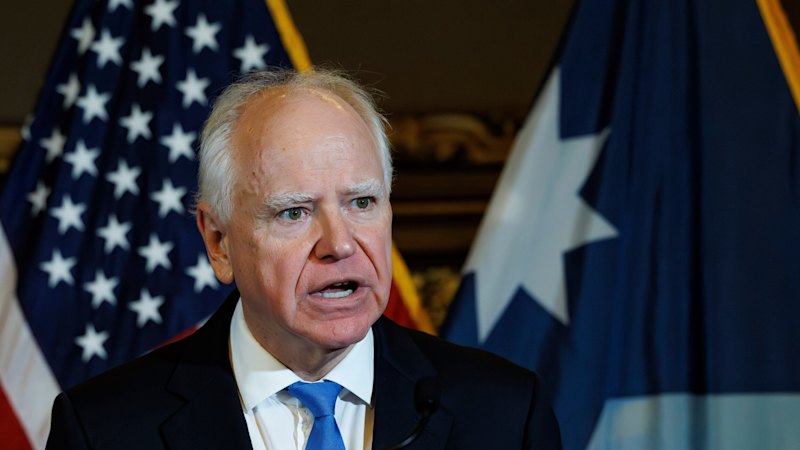
The Justice Department is investigating whether Minnesota Governor Tim Walz and Minneapolis Mayor Jacob Frey obstructed federal immigration enforcement through their public statements. This inquiry, according to two individuals familiar with the situation, centers on possible violations of conspiracy statutes. The sources spoke to The Associated Press on the condition of anonymity due to the sensitive nature of the ongoing investigation.
Governor Walz responded to the investigation by asserting that it represents an attempt to weaponize the justice system against political opponents. “Two days ago it was Elissa Slotkin. Last week it was Jerome Powell. Before that, Mark Kelly. Weaponizing the justice system and threatening political opponents is a dangerous, authoritarian tactic,” Walz stated. His office has claimed it has not received any formal notice regarding the investigation.
Mayor Frey expressed his determination not to be intimidated, stating, “This is an obvious attempt to intimidate me for standing up for Minneapolis, our local law enforcement, and our residents against the chaos and danger this Administration has brought to our streets. I will not be intimidated. My focus will remain where it’s always been: keeping our city safe.”
The investigation unfolds amid a significant immigration crackdown in Minneapolis and St. Paul, characterized by the Department of Homeland Security as its largest enforcement operation to date, resulting in more than 2,500 arrests. The operation has intensified following the fatal shooting of Renee Good on January 7, prompting state and local officials to urge protesters to maintain peaceful demonstrations.
State authorities have issued warnings regarding potential protests against the Trump administration’s immigration actions. Bob Jacobson, Commissioner of the Minnesota Department of Public Safety, emphasized that while peaceful expression is a right, any actions that threaten public safety or result in property damage will not be tolerated. His comments came after President Donald Trump slightly softened his stance on using the Insurrection Act to suppress protests, stating, “I don’t think there’s any reason right now to use it, but if I needed it, I’d use it.”
Legal Controversy Surrounds Detained Immigrant
In a related issue, a Liberian man named Garrison Gibson, who has faced multiple detentions by immigration authorities, was released again after a legal ruling deemed his most recent arrest unlawful. Gibson’s initial arrest, which occurred when immigration agents forcibly entered his residence, was captured on video and sparked public outcry. U.S. District Judge Jeffrey Bryan ruled on Thursday that officials failed to provide adequate notice before revoking Gibson’s order of supervision.
Despite being released, Gibson was detained once more shortly after checking in with immigration authorities. His attorney, Marc Prokosch, explained that Gibson was informed by ICE that an error led to his detainment. Prokosch stated, “In the words of my client, he said that somebody at ICE said they bleeped up and so they re-released him this afternoon and so he’s out of custody.”
Gibson, aged 37, fled civil war in Liberia as a child and has lived in the United States legally under an order of supervision, complying with all requirements to meet regularly with immigration officials. The complexities of his case illustrate the ongoing challenges faced by individuals navigating the immigration system, particularly in the current climate of heightened enforcement.
The developments in Minnesota highlight the tension between state and federal immigration policies and underscore the broader implications for local governance in the face of federal enforcement actions. As this story continues to unfold, both the Justice Department’s investigation and the ongoing immigration operations will likely remain focal points of public discourse.