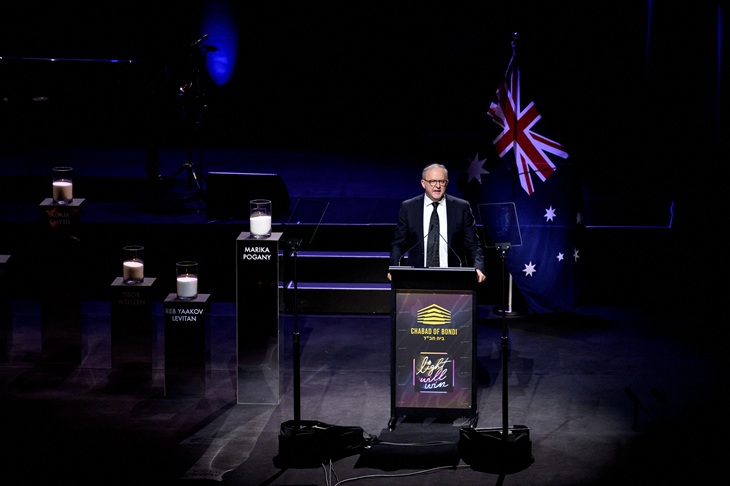
Australia's Prime Minister Anthony Albanese speaks during the "Light Will Win" memorial service at the Sydney Opera House in Sydney on January 22, 2026, as part of the national day of mourning for the victims of the December 14, 2025 Bondi Beach shooting. Australians fell silent and lit candles on a national day of mourning on January 22 for the 15 people killed by gunmen who opened fire on a Jewish festival at Bondi Beach. (Photo by Steven MARKHAM / AFP via Getty Images)
A poignant open letter has emerged, calling on Australian leadership to confront what the author, Aaron J. Shuster, describes as the re-emergence of radical evil in society. Shuster’s letter outlines a pressing dilemma facing not only Australia but the world at large. He argues that current events reveal a dangerous moral crisis, marked by the manipulation of language and the blurring of ethical lines.
Shuster asserts that radical evil does not present itself overtly; rather, it infiltrates discourse through euphemism and moral relativism. He emphasizes that this phenomenon is not merely a series of policy disagreements but a profound challenge to the fabric of democratic society. The author warns that the distortion of language fosters confusion, enabling atrocities to be recast as grievances and violence as resistance.
Understanding the Historical Context
Drawing on the lessons of the 20th Century, Shuster notes that totalitarian regimes did not first arise through overt violence. Instead, they began with the erosion of moral clarity, where victims were often reframed as aggressors and collective responsibility diluted individual accountability. Historical patterns demonstrate that when moral distinctions are compromised, chaos can swiftly follow.
The letter raises concerns about a contemporary trend where historical evils are trivialized. Shuster points out that when actions such as law enforcement are dismissed as authoritarianism, or self-defensive measures are labeled as genocide, genuine moral vigilance erodes. The trivialization of past horrors weakens society’s ability to discern right from wrong, rendering the present landscape increasingly difficult to navigate.
The Role of Leadership in Moral Clarity
Shuster underscores the vital role of leadership in resisting moral collapse. He argues that effective leadership demands clarity—clarity about facts, responsibilities, and the distinction between legitimate authority and criminal acts. He stresses that moral leadership does not require perfection but rather the courage to make judgments when they are most necessary.
The author challenges the misconception that neutrality serves as a moral high ground. In situations where radical evil is present, neutrality equates to abdication of responsibility. Shuster warns that the refusal to take a stand ultimately benefits those who exploit confusion and fear for their own ends.
Reflecting on the burdens of leadership, Shuster notes that history judges leaders not by their eloquence or moral disclaimers but by their recognition of the realities of their time. He identifies failures of recognition as particularly tragic, where leaders overlook warning signs that indicate a moral crisis.
The letter concludes with a stark reminder: if radical evil is allowed to masquerade behind false equivalencies and rhetorical obscurity, it will ultimately reveal itself. Leaders in Australia are faced with a critical question: will they acknowledge and define moral realities, or will they let confusion prevail?
Shuster’s open letter serves as a clarion call to recognize the moment and respond with moral clarity, urging the Australian leadership to act decisively in the face of an evolving crisis.