Astrophysicists have made significant strides toward understanding the enigmatic force that constitutes nearly 70 percent of the Universe. The release of a comprehensive analysis from the Dark Energy Survey (DES), conducted over six years from 2013 to 2019, has provided fresh insights that challenge existing theories about dark energy. While the Universe is expanding, the data suggests that this expansion is not only ongoing but also accelerating, leaving scientists eager to uncover the underlying causes.
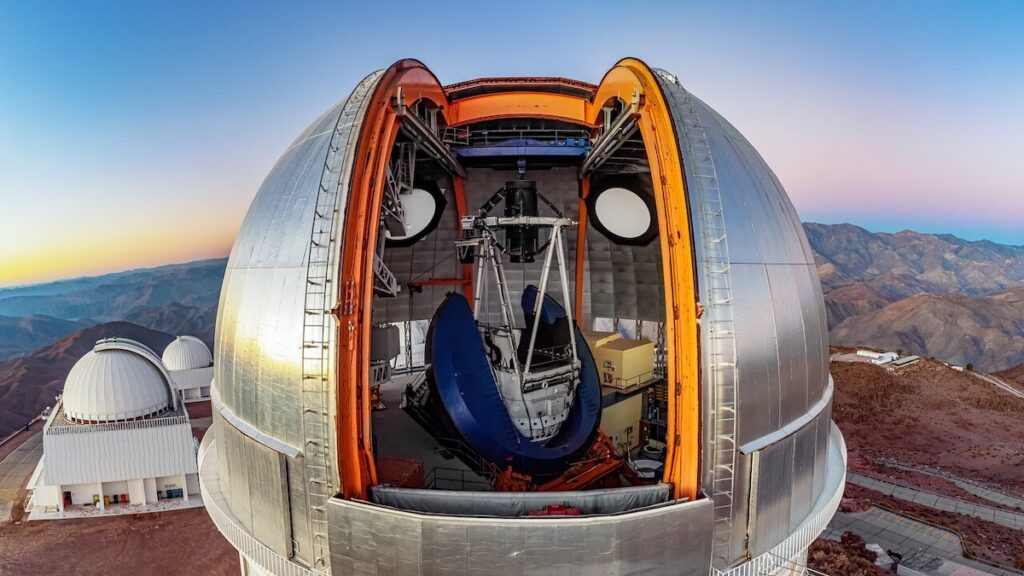
The DES represents a monumental international collaboration that meticulously scanned a vast region of the sky using multiple methods to measure the speed of the Universe’s expansion. The techniques employed included baryon acoustic oscillations (BAO), variations in the brightness of Type Ia supernovae, the distribution of galaxy clusters, and the gravitational lensing effect on light from distant galaxies. This extensive analysis marks the first time that data from all six years and all four methods have been combined, offering the most comprehensive view of dark energy to date.
While the new findings remain consistent with the prevailing cosmological model known as lambda-CDM, which posits a constant density of dark energy over time, they also align closely with an alternative model called wCDM. The lambda component of this model accounts for approximately 68 percent of the total energy in the Universe, while 27 percent is attributed to cold dark matter—an invisible and hypothetical mass. The remaining 5 percent consists of ordinary matter, which encompasses everything from humans to stars like Betelgeuse.
The DES analysis specifically aimed to determine whether dark energy maintains a constant density, as suggested by lambda-CDM, or if it fluctuates at different times, as wCDM proposes. The results indicated that while observations generally matched predictions from the standard model, they also supported the wCDM framework to a similar extent. Notably, the clustering of galaxies in more recent epochs did not completely align with predictions from either model, raising intriguing questions about the nature of dark energy.
While it is premature to draw definitive conclusions from these findings, the results do not yet reach the threshold of five-sigma certainty typically required for confirming new physics. The DES collaboration plans to delve deeper into the new data to evaluate how well other theoretical models fit, potentially leading to revisions in our understanding of gravity itself.
The detailed findings of this groundbreaking analysis are documented in an extensive series of 19 papers, with a summary submitted for publication in the journal Physical Review D. As researchers continue to investigate, the implications of this data may not only deepen our understanding of dark energy but also reshape fundamental concepts in cosmology.