




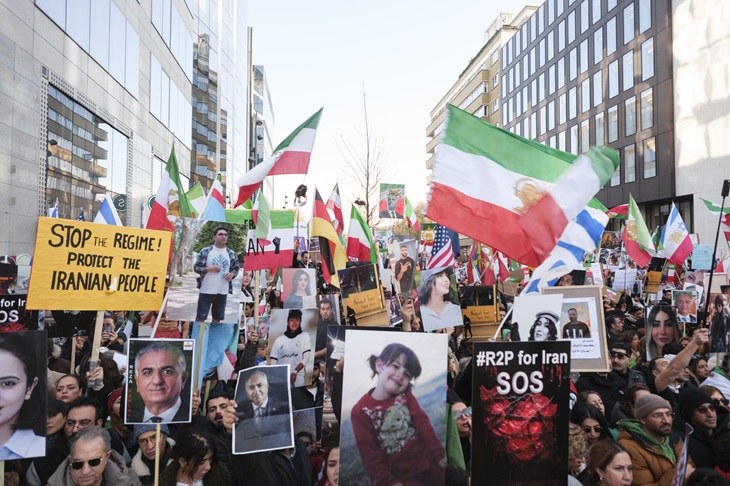
BRUSSELS, BELGIUM - JANUARY 25: Several thousand people gather during a demonstration against 'the regime of the ayatollahs in Iran' on January 25, 2026 in Brussels, Belgium. Today, Iranian communities are rallying beside the Robert Schuman Roundabout in Brussels to show support for the ongoing uprising in Iran and to call for a democratic republic. The demonstration is part of a broader wave of global protests against the Iranian government, reflecting solidarity with the Iranian people's struggle for freedom and representation. (Photo by Thierry Monasse/Getty Images)
URGENT UPDATE: The humanitarian crisis in Iran has reached a devastating turning point as a new report from The Times confirms the death toll of protesters has soared to a staggering 30,000. This alarming figure is not merely a number; it signifies the potential for a brutal civil war that could spill over beyond Iran’s borders.
The situation is dire. As of October 2026, leaders in Washington, Brussels, and Canberra cling to a dangerous doctrine of ‘non-intervention,’ convinced that inaction will prevent another Middle Eastern conflict. However, recent events suggest otherwise. The choice facing the international community is clear: either intervene to halt the oppressive regime or risk plunging Iran into chaos.
The fallacy of the so-called ‘South Africa Model’—a peaceful resolution similar to the end of Apartheid—is becoming increasingly evident. Unlike South Africa, the Iranian regime is executing its citizens at an alarming rate, obliterating any hope for diplomatic negotiation. The consequences of inaction could mirror the Syrian catastrophe of 2011, where the world watched as peaceful protests devolved into a protracted civil war, resulting in widespread destruction and mass displacement.
The implications of a civil war in Iran would be catastrophic not only for its citizens but for the entire world. Should Iran fracture, experts warn of an unprecedented migration crisis, potentially displacing 30 to 40 million people. The ripple effects would destabilize Europe and extend even to Australia, whose shores would not be immune to the fallout.
Furthermore, the economic consequences could be dire. With 20 percent of the world’s oil passing through the Strait of Hormuz, any civil unrest could disrupt vital shipping lanes, leading to skyrocketing fuel prices and severe supply chain issues. Countries like Australia would face immediate economic repercussions.
As the Iranian public loses hope for reform, desperation grows. The sentiment has shifted from seeking change to craving ‘national order.’ However, with the regime’s brutal repression, the psychological breaking point looms nearer. If the international community remains silent, the populace may turn to armed groups, leading to an even more fractured and violent response.
The key to preventing a total state collapse lies within Iran’s National Army (Artesh). Unlike the ideologically driven IRGC, the Artesh has a broader base of support and has largely refrained from participating in the state’s violence. However, they remain constrained by the overwhelming power of the IRGC. External intervention could foster a crucial shift, allowing the Artesh to stabilize the situation and manage a transition away from violence.
Experts suggest a targeted air campaign akin to the Bosnia 1995 model could be the solution. Such an intervention would dismantle the oppressive structures of the IRGC, offering the National Army a chance to step in and restore order. The time for decisive action is now.
The reality of 2026 is stark: those advocating for inaction may unknowingly be paving the way for one of the bloodiest civil wars in Iranian history. It is essential to act swiftly to prevent further loss of life and to preserve global stability. The world must heed this urgent call to action. The blood of 30,000 has already spoken—a reminder that hesitation could mean the difference between survival and catastrophe.
As this situation develops, the international community’s response will be critical in shaping Iran’s future. The time to intervene is now, before it becomes too late.
