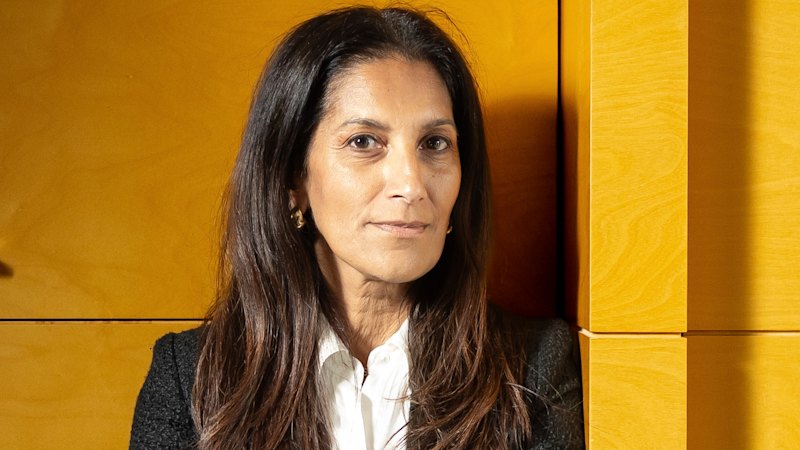
Xero’s chief executive, Sukhinder Singh Cassidy, has firmly rejected claims from skeptical software investors that the company’s accounting products can be easily replicated by artificial intelligence. In a presentation to investors, she emphasized that Xero’s proprietary data and established banking infrastructure provide a significant competitive advantage over newer contenders in the market.
Xero’s share price has seen a dramatic decline, falling from $194.51 in June to $95.60 on Tuesday. Analysts attribute this drop to a combination of factors, including concerns that AI technologies might disrupt traditional software business models. Notably, major players like Atlassian, Microsoft, SAP, and ServiceNow also experienced significant sell-offs amid fears surrounding AI’s impact on the software industry.
In her investor presentation, Singh Cassidy shared her experience using Anthropic’s Claude coding tools to attempt to clone Xero. She noted that while AI tools are advancing, they still lack the extensive transaction data and banking connections necessary to effectively compete in the accounting software space. “You’re still going to need to hook up thousands of bank feeds. You still need to process the data. That data is proprietary. We use it to train our models,” Singh Cassidy stated.
She further explained that the existing investor sentiment fails to differentiate between software that may succeed and those that could be more vulnerable to disruption. Singh Cassidy expressed her belief that AI will not only expand Xero’s market but also enhance the functionality of its offerings.
Xero specializes in accounting and payment software for small businesses and bookkeepers. Recently, the company has introduced new AI agents designed to streamline processes such as invoice creation and account reconciliation with bank records. Its JAX (Just Ask Xero) agent, for instance, can analyze financial data and answer queries like, “Can I afford to buy a $20,000 delivery van next month?”
The firm’s chief product officer, Diya Jolly, indicated that Xero plans to unveil additional AI features in the near future, with plans to start charging customers for these enhancements by 2027. “We believe that software-as-service apps will transform over time. You will move from having a user interface, where users input information, to having users manage agents,” Jolly remarked.
Currently, about 2 million of Xero’s 4.6 million subscribers are taking advantage of its traditional AI features, while 300,000 subscribers are utilizing the newly launched generative AI capabilities.
Financial analyst Paul Mason from E&P Capital expressed skepticism about the potential for generative AI to significantly diminish Xero’s market share. He emphasized that Xero’s core strength lies in its highly accurate database, suggesting that the accounting software industry presents a new competitive landscape among existing players rather than a direct threat from AI.
Xero has reaffirmed its financial guidance for the year, indicating that its recent acquisition of Melio is on track to break even in the second half of 2028, earlier than previously expected. Analyst Garry Sherriff from RBC Capital Markets noted that this update, alongside a demonstration of Melio’s product, should reassure investors. Following the presentation, Xero’s shares experienced a modest increase of 2.5 percent.
The acquisition of Melio, which was finalized in October, is anticipated to boost Xero’s revenue growth in the U.S. market and is part of the company’s strategy to more than double its revenue to $NZ4.2 billion (approximately $3.6 billion) within the next three years. Xero plans to provide a detailed revenue growth guidance when it reports its financial results in May, illustrating how it aims to achieve its growth targets by 2028.