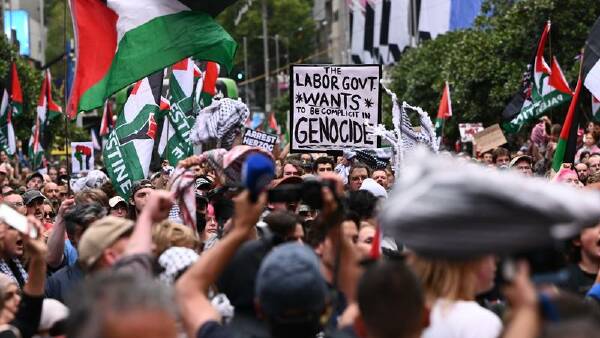
A significant protest against the visit of Israeli President Isaac Herzog erupted into chaos in Australia, leading to clashes between police and demonstrators. The protests, which took place in major cities including Sydney and Melbourne, involved thousands of people expressing their opposition to Herzog’s tour. Tensions escalated when police deployed pepper spray and made multiple arrests in Sydney’s Town Hall area, where protesters had gathered despite a Supreme Court ruling prohibiting the demonstration.
In Sydney, the rally drew an immense crowd, spilling out of Town Hall and into surrounding streets. Police had ordered protesters to disperse before resorting to pepper spray and physical force to clear the area. Witnesses reported that people attempting to leave were unable to move as police formed a barrier, resulting in a standstill. The police action came after the NSW Supreme Court ruled against a challenge to the government’s declaration of Herzog’s visit as a major event, which granted law enforcement additional powers to manage the crowd.
Amnesty International Australia’s Mohamed Duar addressed the rally, stating, “Herzog’s visit is an affront to all Australians that care about human rights and peace and justice.” The event featured speakers such as former Australian of the Year Grace Tame and Greens senator Mehreen Faruqi, who voiced strong criticisms of Israel’s actions and their implications for human rights.
In Melbourne, protesters similarly demonstrated against Herzog’s visit, blocking major intersections during the Monday evening rush hour. Speaker Omar Hassan led the crowd outside Flinders Street Station, calling for Herzog to be tried in the International Criminal Court. He emphasized the need to challenge what he termed “the mass murder of children, men and women” associated with Herzog’s policies.
Independent senator Lidia Thorpe condemned the federal government’s invitation to Herzog, calling it “a joke” and arguing that inviting someone with a record of violence undermines respect for human rights.
Less than an hour before the planned protest in Sydney commenced, the NSW Supreme Court dismissed a legal challenge to the government’s declaration, which was criticized by protesters as overly broad. Lawyers argued that it failed to specify participants or geographic areas adequately. However, government barrister Brendan Lim SC countered that the declaration aimed to relocate the protest to Hyde Park, where similar events had been held previously.
This legal framework for managing protests was fortified in response to the December 2022 Bondi Beach terror attack, allowing police to enforce stricter measures for events deemed major. In this context, Herzog’s visit has been particularly controversial, given his recent actions. He faced backlash for being photographed signing an Israeli artillery shell and for comments made following the October 7, 2023, Hamas attack on Israel, which a United Nations inquiry suggested could be interpreted as incitement to genocide.
The protests in Australia reflect growing discontent over international figures associated with controversial military actions visiting the country, illustrating the challenges of balancing diplomatic relations with public sentiment regarding human rights. As the situation continues to unfold, the impact of these demonstrations on future engagements with international leaders remains to be seen.