




UPDATE: Despite alarming evidence, only a handful of fines are issued for violating cyclist safety regulations in Queensland. Just 36 infringements related to cyclists were recorded last year, raising urgent concerns about road safety for vulnerable riders.
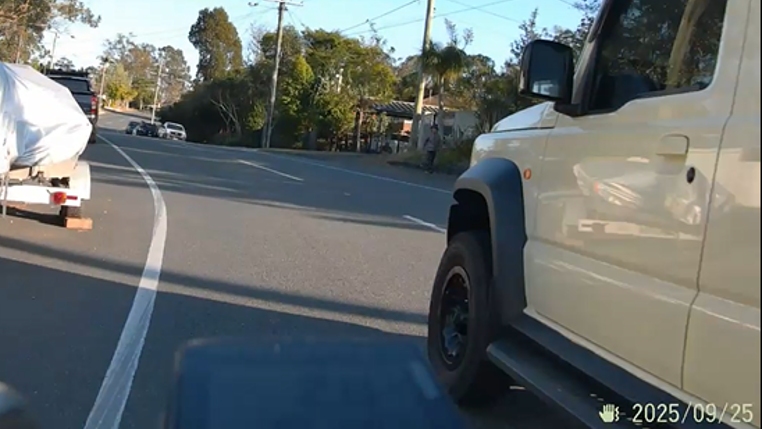
In a recent incident, Michael Bradbrook was nearly struck while cycling on Chapel Hill Road at 7:00 AM. A four-wheel drive sped past him, violating the one-metre minimum passing distance law, which marked its 10th anniversary this year. “I felt the wind on my elbow and shoulder; it was terrifying,” he reported.
Despite using camera footage to report the incident, which resulted in a $500 fine for the driver, many cyclists find little action taken against offenders. In Queensland, motorists must maintain a distance of 1.0 meters when passing cyclists in zones under 60 km/h, and 1.5 meters in higher speed areas. However, riders frequently experience close calls, with a survey by Amy’s Foundation revealing that nearly every cyclist has faced such risks, and 54 percent report close passes on almost every ride.
The law, made permanent in 2016 after a series of cyclist fatalities, including the tragic death of violinist Richard Pollett, has failed to deliver adequate enforcement. Last financial year saw a mere two fines issued for e-scooter violations, highlighting the enforcement gap. From riders who submitted video evidence of close passes, only one in three resulted in a fine, while 28 percent received no response from police.
Katherine Bates from Amy’s Foundation emphasized the need for stronger enforcement and driver education. “What’s missing is consequence,” she stated, urging Queensland to adopt a model similar to the ACT. This would allow cyclists to submit video evidence directly to police for efficient follow-up on violations.
Matthew Burke, CEO of Bicycle Queensland, echoed the community’s concerns, noting, “Drivers are increasingly ignoring the minimum passing distance rules.” He called for a public awareness campaign to remind drivers of their responsibilities toward cyclists.
Queensland Police reiterated their commitment to road safety, asking drivers to remain vigilant and patient around cyclists and personal mobility devices. A spokesperson stated, “We ask drivers to ensure they allow the minimum passing distance.”
Research from CARRS-Q indicates that enforcing the law is challenging, especially on narrow roads. In contrast, a study from Western Australia showed that while publicity campaigns made minor improvements in overtaking behavior, protected cycling infrastructure significantly enhances safety.
The government’s StreetSmarts program aims to raise awareness about the minimum passing distance rule, reaching over 1.5 million road users annually. Authorities are expected to continue promoting this initiative into 2026.
As the cycling community pushes for better enforcement and safety measures, the message is clear: every cyclist deserves respect and protection on the road. With more awareness and accountability, the hope is to reduce the alarming statistics of close passes and ensure safer journeys for all road users.
