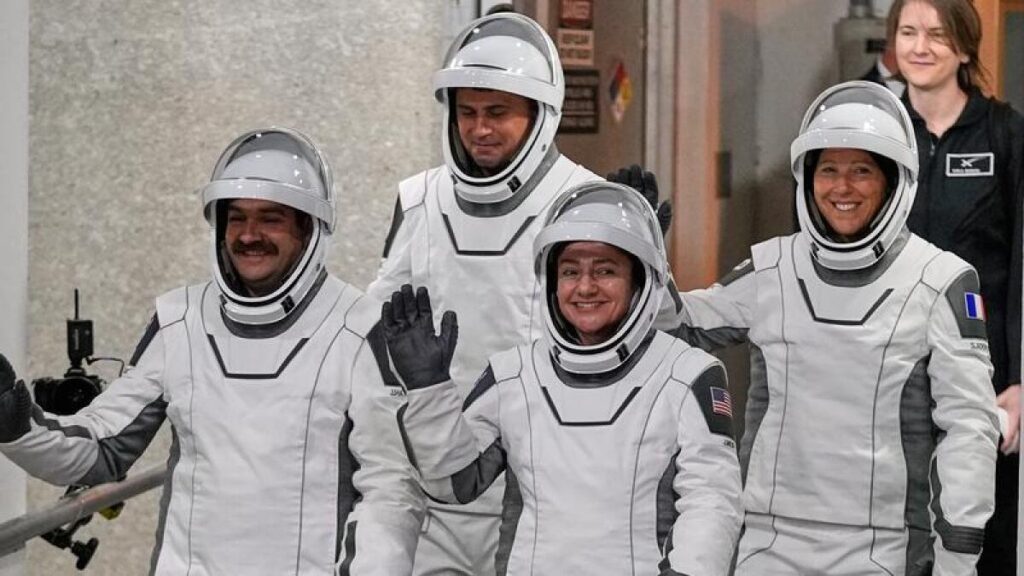
A new crew of astronauts launched to the International Space Station (ISS) on March 15, 2024, to fill the vacancies left by their colleagues who were evacuated earlier this year due to a medical emergency. The four astronauts, representing NASA, France, and Russia, are expected to arrive at the ISS on March 16, 2024, restoring the station’s full operational capacity and allowing for the resumption of planned activities.
NASA had suspended spacewalks and other critical tasks while awaiting the arrival of Jessica Meir, Jack Hathaway, Sophie Adenot, and Andrei Fedyaev. The crew will join three other astronauts—one American and two Russians—who have been maintaining operations aboard the ISS since the evacuation in January. Notably, NASA did not require additional health checks for the new crew prior to lift-off, relying on established medical protocols and equipment already present on the station.
The evacuation incident marked a significant moment in space exploration history, as it was the first time in 65 years of human spaceflight that a mission was cut short for medical reasons. Following their return to Earth, the evacuated astronauts received immediate medical attention after splashing down in the Pacific Ocean off the coast of California. NASA has not disclosed the identity or specific health issues of the affected astronaut.
Innovative Medical Research on the ISS
The new crew’s mission includes testing several innovative medical technologies that could prove essential for future lunar and Martian expeditions, where healthcare will be more complex. Among their tasks, they will evaluate a filter designed to convert drinking water into emergency intravenous (IV) fluid and utilize an ultrasound system incorporating artificial intelligence and augmented reality for medical diagnostics. Additionally, they will conduct ultrasound scans of their jugular veins as part of a study on blood clots.
In a demonstration of their skills, the astronauts will also engage in a simulated moon landing, contributing to NASA’s preparations for upcoming missions to the lunar surface. The presence of Adenot, only the second French woman to travel to space, adds a remarkable dimension to this expedition. Inspired by the pioneering astronaut Claudie Haignere, who flew to the Russian space station Mir in 1996, Adenot has achieved her dream with Haignere present at Cape Canaveral to support her launch.
Both Hathaway and Adenot are making their first journeys to space, while Meir and Fedyaev return for their second missions. Meir gained recognition during her initial mission in 2019, when she participated in the first all-female spacewalk alongside astronaut Christina Koch, who is also among the four astronauts slated for the upcoming Artemis II mission, expected to venture around the moon as early as March 2025.
SpaceX facilitated the launch from the Cape Canaveral Space Force Station, with Elon Musk’s company preparing its nearby Kennedy Space Center for the deployment of larger spacecraft designed for moon landings. The successful arrival of this new crew marks a crucial step in maintaining continuous human presence aboard the ISS and advancing preparations for future exploration beyond Earth.