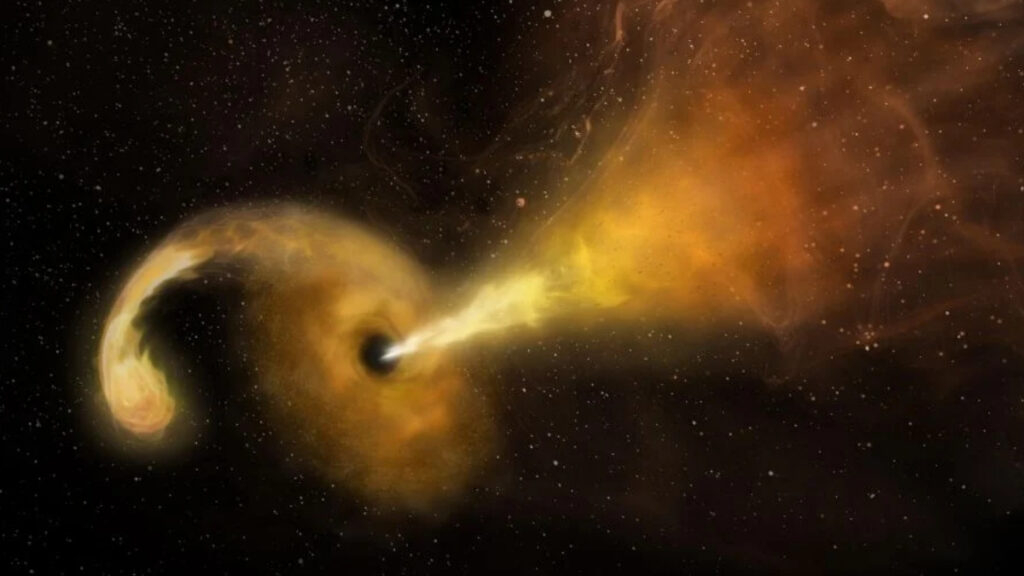
A supermassive black hole (SMBH) located in a distant galaxy has been found to emit energy levels that could surpass the fictional Death Star from the *Star Wars* franchise by up to 100 trillion times. This discovery stems from the tidal disruption event (TDE) known as AT2018hyz, where a star was consumed by the black hole’s intense gravitational pull. The event was initially detected in 2018, but new research reveals that the energy output is still increasing, significantly enhancing our understanding of black hole behavior.
The TDE AT2018hyz was first observed by the All Sky Automated Survey for SuperNovae (ASASS-SN) in 2018, but it wasn’t until 2022 that radio emissions were detected. According to a recent study published in *The Astrophysical Journal*, the energy output from this event has risen sharply, now measured to be 50 times brighter than when it was first observed. Lead author, Yvette Cendes, an Assistant Professor in the Department of Physics at the University of Oregon, emphasized the significance of these findings.
Understanding the Rising Energy Emissions
The researchers conducted radio observations spanning from approximately 1,370 to 2,160 days after the star’s disruption. In their paper, Cendes and her colleagues noted, “We find that the light curves continue to rise at all frequencies during this time period.” This continuous increase has raised questions about the underlying processes fueling such extraordinary emissions.
Two primary scenarios could explain the observed luminosity. The first is a “delayed spherical outflow,” which suggests that the outflow was launched around 620 days after the star was consumed. Cendes explained that “the physical evolution of the radius for a spherical outflow supports an outflow that was launched with a substantial delay.” The second scenario involves an astrophysical jet, which would be traveling at relativistic speeds. The research indicates that the radio emissions from this jet may initially be suppressed but will rise dramatically as the jet decelerates and disperses.
The researchers predict that the stream of radio waves from the SMBH will continue to rise, potentially peaking in 2027. Cendes remarked, “This is really unusual. I’d be hard-pressed to think of anything rising like this over such a long period of time.”
Comparing Cosmic Energy Outputs
In a striking comparison, the energy emitted by the SMBH is found to be comparable to that released by a gamma-ray burst (GRB), which is among the brightest and most powerful explosions in the universe. By utilizing calculations made by *Star Wars* fans regarding the Death Star’s energy output, the research team determined that the SMBH is emitting at least one trillion times more energy than the fictional space station, with the possibility of this figure reaching 100 trillion times.
Despite the remarkable nature of these findings, uncertainties remain. Cendes pointed out, “If you have an explosion, why would you expect there to be something years after the explosion happened when you didn’t see something before?” She also noted the challenges of acquiring observation time on major telescopes, which can be highly competitive.
This discovery prompts further investigation into whether other black holes and TDEs exhibit similar rising radiation patterns. While AT2018hyz stands out due to its extreme luminosity, the authors acknowledge that it is not the only TDE with delayed radio emissions. They assert, “We find that AT2018hyz is a unique TDE even within the population of TDEs with delayed radio emission.”
Cendes and her team plan to continue monitoring AT2018hyz across multiple frequencies, which will help clarify the ongoing evolution of the outflow and its surrounding environment. As this research unfolds, it may illuminate new aspects of black hole behavior and deepen our understanding of the universe’s most energetic phenomena.