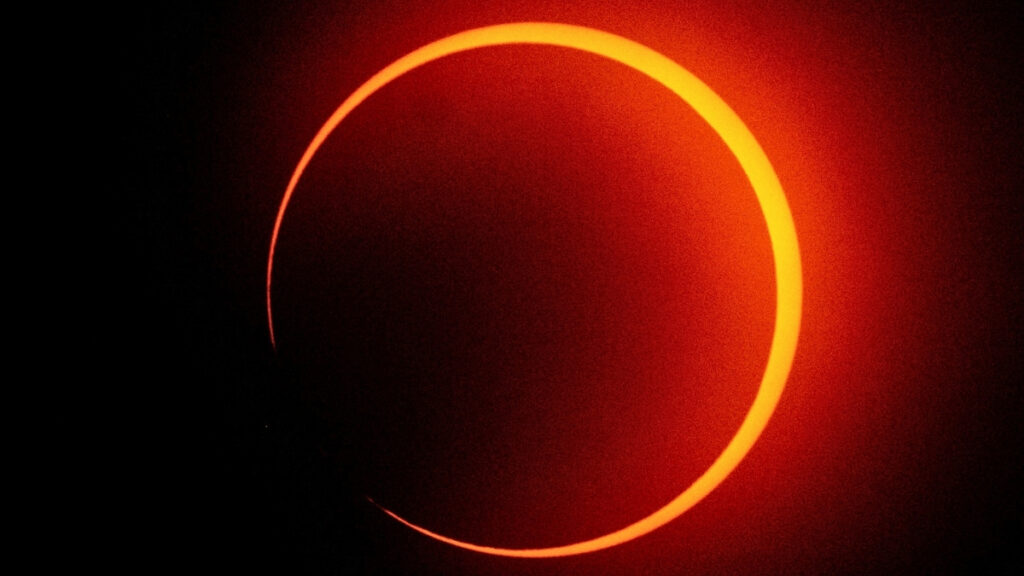
Antarctica is set to witness a rare annular solar eclipse on October 14, 2023, a celestial event that is often referred to as a “ring of fire.” This phenomenon occurs when the moon, positioned farther from Earth in its orbit, only partially covers the sun, leaving a bright ring visible around its edges. Unlike total solar eclipses, where the sun is completely obscured, this event will allow observers in Antarctica to see a unique display as the moon moves between the sun and the Earth.
According to Joe Llama from the Lowell Observatory, this eclipse presents a spectacular opportunity for those stationed in Antarctica, where clear skies could enhance visibility. “The penguins down there are going to have a great show,” he remarked, highlighting the diverse wildlife that inhabits the region.
Viewing Opportunities Beyond Antarctica
While the annular eclipse will be most prominent in Antarctica, regions such as Chile, Argentina, and parts of southeastern Africa, including Madagascar and South Africa, will experience a partial eclipse. Observers in these areas will see distinct bites taken out of the sun, providing a glimpse of the celestial alignment.
Solar eclipses occur when the sun, moon, and Earth align perfectly, a phenomenon described by Emily Rice from the City University of New York as a “beautiful coincidence between the size and the distance of the moon and the sun.” This week’s event is particularly notable, as it is among the few solar eclipses visible from the southernmost continent.
Safety and Viewing Methods
As with any solar eclipse, safety is paramount. Looking directly at the sun can cause serious eye damage, even during an annular eclipse. Experts recommend using certified eclipse glasses that meet ISO 12312-2 standards, ensuring they effectively block harmful ultraviolet rays. Ordinary sunglasses and binoculars do not provide adequate protection.
For those without eclipse glasses, alternative viewing methods can be employed. Creating a pinhole projector with household items or using a colander or cheese grater can allow viewers to safely observe the eclipse indirectly.
Looking ahead, a total solar eclipse is scheduled for August 12, 2024, which will be visible in locations including Greenland, Iceland, Spain, and parts of Portugal. This upcoming event will also feature partial eclipses across large sections of Europe, Africa, and North America.
As the world anticipates the upcoming eclipse, both seasoned astronomers and casual observers alike are eager for the spectacle that unfolds in Antarctica and beyond. Whether through careful observation or creative viewing techniques, the beauty of the cosmos will be on display for those fortunate enough to witness it.