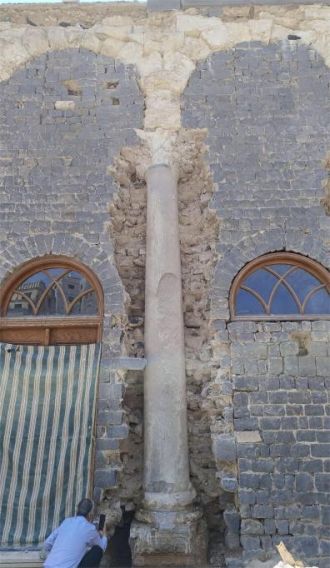
A newly discovered Greek inscription at the base of a column in the Great Mosque of Homs, Syria, has reignited scholarly discussions regarding the site of the ancient Temple of the Sun, associated with the Roman Emperor Elagabalus. This inscription, found during restoration efforts, may provide crucial evidence in determining the relationship between the mosque and the temple believed to have existed in the third century AD.
The Great Mosque, esteemed for its oval layout, sits in Homs, the capital of the province of the same name. Historically known as Emesa, the city has been lauded for its rich heritage, including the mosque that has undergone various transformations over centuries. The recent findings underscore its layered religious significance, which evolved from a pagan temple to a Christian church and ultimately to a prominent Islamic site.
Dr. Maamoun Saleh Abdulkarim, a professor of archaeology and history at the University of Sharjah, has published a study in the archaeology journal Shedet that explores the implications of this inscription. “This inscription provides new evidence in a long-standing debate: Was the Temple of Elagabalus located beneath the current Great Mosque, or was it situated in the archaeological layers atop the tell, where the remains of the Islamic Citadel of Homs now stand?” he explained.
Tracing Religious Transformations
The debate surrounding the origins of the Great Mosque of Homs has persisted for decades. Scholars have explored various forms of evidence—textual, numismatic, and archaeological—to piece together the site’s historical narrative. The discovery of the Greek inscription has now opened a new avenue for research.
Dr. Abdulkarim’s analysis aims to establish connections between the current mosque and earlier pagan and Christian religious sites. He emphasizes that if the inscription is linked to solar cult symbolism, it could indicate a continuity of worship practices on the site. “Such evidence would significantly strengthen the argument that religious transformation in Emesa occurred through architectural layering and reinterpretation rather than a complete break,” he stated.
The study places Homs within a broader context of three major religious phases: paganism, Christianity, and Islam. It provides a unique perspective on how these faiths intertwined and adapted over time. “The evolution of religious life in Emesa during Roman and early Byzantine times illustrates how the city transitioned from the worship of local deities to the acceptance of Christianity,” Dr. Abdulkarim noted.
The inscription itself, engraved in Greek and measuring approximately 1 meter by 1 meter, was uncovered beneath the mosque’s floor during excavations that began in 2016. It features a symmetrical, formal writing style typical of commemorative texts, with a passage that evokes the imagery of a heroic ruler. According to Teriz Lyoun, head of the Excavation Department in Homs, the text portrays a warrior-king likened to natural forces, emphasizing his commanding authority in combat.
Historical Significance of Emesa
The implications of the Greek inscription extend beyond mere academic debate; they shed light on Emesa’s role as a significant religious and commercial center throughout history. The city served as a crucial nexus linking ancient trade routes, particularly those connecting Antioch, Damascus, and the broader Levant.
Dr. Abdulkarim highlights the significance of Emesa’s religious identity, rooted deeply in its pagan past. “The Roman identity of Emesa was fundamentally based on paganism,” he stated, noting that the city’s spiritual life revolved around Elagabalus, its local solar deity. The temple dedicated to this deity was central to seasonal festivals and religious observances in the region.
The transformation from a temple to a church and finally to a mosque reflects a broader theme of continuity rather than rupture in religious practices. Dr. Abdulkarim argues that the coexistence of paganism and Christianity was a gradual process rather than an abrupt replacement. “Religious change is rarely instantaneous; in Emesa, pagan and Christian practices coexisted for decades, much like the ongoing coexistence of Islam and Christianity in Homs and greater Syria,” he remarked.
As archaeological efforts continue, the inscription stands as a testament to Emesa’s enduring significance. It not only enriches the historical narrative of the Great Mosque but also contributes to our understanding of religious evolution in the region.
Dr. Abdulkarim’s research illustrates how sites like Emesa retain their historical identities while adapting to new religious paradigms. “Cities do not erase their past but reinterpret it,” he concludes. The ancient Temple of the Sun, despite its transformation over the centuries, continues to influence the cultural and religious landscape of Homs, underscoring the complexities of faith and identity throughout history.