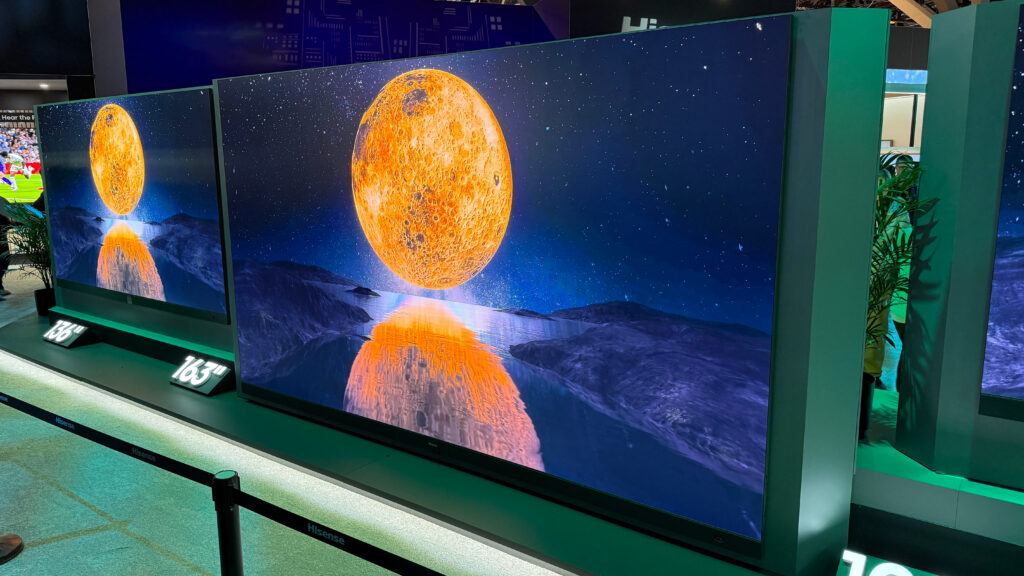
Recent analysis reveals that the price of next-generation micro-LED televisions is unlikely to decrease in the near future. A report by the respected firm UBI Research provides a detailed breakdown of the manufacturing costs associated with these premium TVs, highlighting that substantial advancements are necessary before these devices become more affordable for consumers.
The report, titled “101-inch Micro-LED TV Set BOM Analysis Report… Signaling a Game Changer for the Consumer Electronics Market,” indicates that the Bill of Materials (BOM) for a 101-inch micro-LED television stands at approximately $52,000 (around £38,550 / AU$73,815). This figure reflects only the manufacturing costs and does not account for additional expenses such as distribution, marketing, or retailer markups. Consequently, a retail price of around $100,000 for a 100-inch micro-LED TV is anticipated.
Several manufacturers, including Hisense and Samsung, have showcased impressive micro-LED models. These include Hisense’s striking 163-inch micro-LED and Samsung’s innovative concept with a bezel that doubles as a screen. Despite the excitement surrounding these advancements, the cost remains a significant barrier for most consumers.
A key factor contributing to the high price of micro-LED TVs is the complexity of their components. The UBI Research report outlines that the panel materials, which include micro-LED pixels, account for an astonishing 86.2% of the total BOM. Specifically, the pixel layer costs $28,913, while the backplane adds another $15,932. Other components, such as the mainboard and driving circuit module, also contribute significantly to the overall cost.
Established technologies like OLED and mini-LED have benefitted from greater manufacturing efficiencies due to their large-scale production. As a result, these technologies have seen a decline in prices over time. In contrast, micro-LED technology faces challenges in producing core materials, making cost reductions difficult. According to Dr. Joohan Kim, Senior Analyst at UBI Research, “For micro-LED TVs to become mainstream in the large-size premium market, improving process yield and reducing cost through vertical integration will be essential.”
The report suggests that the modular nature of micro-LED technology could help reduce production costs in the long run. Smaller panels can be easily combined to create larger displays, allowing for more efficient manufacturing processes. However, despite these potential advantages, manufacturers warn that mainstream adoption of micro-LED technology is still five years away.
As this technology evolves, the prospects for micro-LED TVs remain promising. They offer a self-emissive structure capable of achieving “virtually unlimited scalability beyond 100 inches” while providing exceptional black performance. Nonetheless, for consumers with modest budgets, it may be wise to explore current television options that offer better value.
As interest in micro-LED technology continues to grow, consumers should stay informed about potential advancements. For those contemplating a new television purchase, resources such as size and model finders can assist in making an informed decision based on viewing distance and preferences.
For the latest updates on television technology and reviews, follow credible sources that provide expert insights and recommendations.