Researchers in the United States have made significant strides in optical astronomy by demonstrating how quantum entanglement can enhance the detection of optical signals from astronomical sources at the single-photon level. This breakthrough, led by Pieter-Jan Stas at Harvard University, was published in the journal Nature on March 8, 2026. The team successfully detected extremely weak light signals over a fiber link extending more than 1.5 kilometers, potentially setting the stage for optical telescopes with unprecedented resolution.
Interferometry, a technique frequently used in astronomy, allows for the creation of high-resolution images from distant celestial objects. By combining light collected across spatially separated detectors, it achieves resolutions that can rival those of a single telescope with a diameter equal to the distance between the detectors. The Event Horizon Telescope famously utilized this method to capture the first direct image of a black hole, known as Messier 87, in 2019.
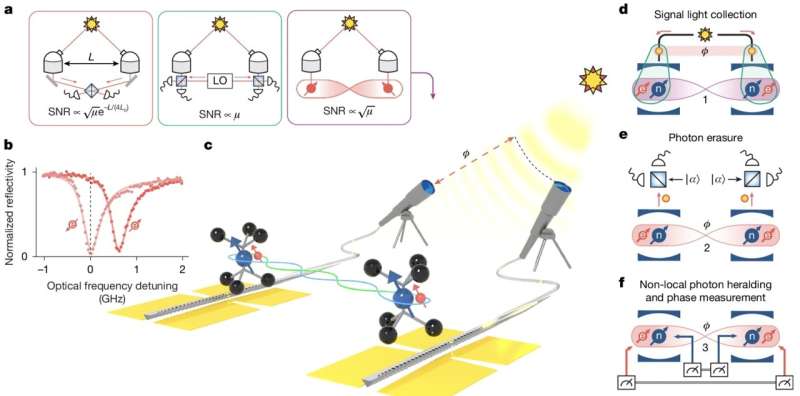
Despite its successes, optical interferometry has inherent limitations. For visible or infrared light, signals are detected at the level of individual photons. To recover the necessary phase information for interferometry, photons collected by various telescopes must be combined and interfered with at a central measurement point. A crucial aspect of this system is ensuring that no information is retained regarding which telescope detected each photon. This process, while effective, requires transporting photons over long distances, leading to significant information loss as they travel. Consequently, optical interferometer networks are generally restricted to baselines of around 300 meters, severely impacting their resolution capabilities.
In 2012, theoretical physicist Daniel Gottesman proposed that quantum entanglement could extend this range. If multiple detectors share an entangled quantum state, an incoming photon can interact with that state without needing to be physically transported to a central location. Practical implementation of this idea has faced challenges, particularly in generating and distributing entanglement at the rates required for effective observation.
Stas’s team addressed these challenges by utilizing “quantum memories” based on silicon-vacancy centers embedded in diamond nanocavities. These defects in the diamond lattice can store quantum information for extended periods by mapping the spin of an electron onto the more stable spin of a nearby atomic nucleus. By establishing remote entanglement between two of these memories situated at separate stations connected by optical fiber, the researchers could map weak optical signals arriving at the stations onto the entangled memories. Crucially, they also ensured that the information regarding which detector had received the photon was erased.
The system included non-local photon heralding, confirming that a photon was detected while filtering out background noise. These combined efforts enabled the researchers to perform a differential phase measurement of weak incoming light between the two stations, with the stations separated by up to 1.55 kilometers—a significant advancement compared to typical baselines in current optical interferometry.
While this development is promising, the path to practical applications in astronomy remains lengthy. The rate of entanglement generation is currently limited, restricting Stas’s team to data collection at approximately 12 millihertz. Additionally, misidentified detection events contributed to increased noise levels, particularly when photon counts were low. Despite these challenges, the demonstration indicates that the fundamental components of entanglement-assisted interferometry can function effectively.
Looking ahead, the researchers are optimistic that improvements in entanglement generation could lead to a new class of quantum-enhanced imaging techniques. This advancement could significantly impact optical astronomy and deep-space communication, opening avenues for exploring the universe in greater detail than ever before.