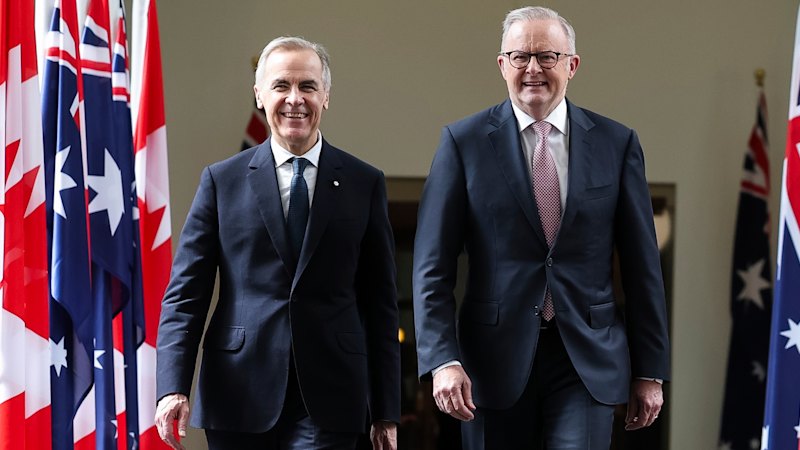
Canada’s approach to immigration contrasts sharply with Australia’s, particularly in light of recent actions taken by the Canadian government under the leadership of Finance Minister Francois-Philippe Champagne. While both Anthony Albanese and Mark Carney promote the benefits of immigration, Canada has implemented measures that have effectively led to no net immigration increase this year. This decision reflects a response to community concerns regarding housing and infrastructure, which resonate in both nations.
During his recent visit to Australia, Champagne articulated the need for balance in immigration, stating, “There’s a fundamental principle that if you accept people in the country, they need to be able to find a place to live, they need to be able to send their kids to school, and they need to be able to go to hospital if they need medical services.” His remarks highlight a significant shift in policy aimed at addressing imbalances created by high levels of immigration, particularly in urban areas.
In stark contrast, the Albanese government anticipates that Australia’s net overseas migration will drop to approximately 260,000 this financial year, down from a peak of 540,000 three years ago. Despite these reductions, there remains a pervasive sentiment among the Australian public that immigration levels are still too high, exacerbated by rising housing costs and concerns about public services.
Comparative Immigration Policies
The differences in immigration policy between Canada and Australia are evident in their respective approaches to temporary and permanent migration. Canada has significantly reduced its temporary migration visas, which has contributed to the decline in housing demand and prices. Australia’s immigration system, conversely, has been characterized by a surge in temporary visa holders, complicating the government’s ability to manage public sentiment effectively.
While Canada maintains a relatively stable permanent immigration intake of around 380,000 annually for its population of 41 million, Australia’s annual permanent intake hovers around 210,000. The disparity in temporary resident numbers is noteworthy, as they represent over 9 percent of Australia’s population, compared to Canada’s target of less than 5 percent.
The Albanese administration faces mounting pressure to reconcile these immigration dynamics, particularly as public discontent continues to grow over issues like housing affordability. Complaints about crowded transportation systems and social services add further complexity to the evolving immigration debate.
Champagne’s comments underscore Canada’s proactive stance on immigration control, stating, “If people feel it’s not under control, then you have an issue. We needed to take back control.” The unemployment rate in Canada, currently around 6.5 percent, contrasts with Australia’s lower rate of 4.1 percent, indicating differing labor market conditions that influence immigration policies.
Impact on Education and Employment
The ramifications of these immigration policies extend to the education sector, particularly for universities that depend on international students for financial stability. Canada has seen a significant reduction in international student numbers, from over 1 million in January 2024 to an expected 725,000 by September 2025. This decline has been mirrored in Australia, where international students constitute about 40 percent of net overseas migration.
Despite the challenges, Australian employers continue to express concerns regarding labor shortages in critical sectors such as construction. With net overseas immigration reductions, the mismatch in skilled labor is expected to worsen. Many businesses, including local cafes and beauty parlors, rely on temporary visa holders to meet their staffing needs.
The Albanese government has struggled to formulate a coherent strategy to address these pressing issues. Former deputy secretary of the Department of Immigration, Abul Rizvi, suggests three potential paths forward: increasing permanent immigration, cutting the skilled stream, or continuing the current approach of postponing decisive action.
As Canada navigates its immigration landscape, the lessons learned may provide valuable insights for Australia. Achieving a sustainable balance between immigration levels and community needs remains a critical challenge for both governments. The future of immigration policy in Australia hinges on its ability to address public concerns while fostering economic growth and social cohesion.