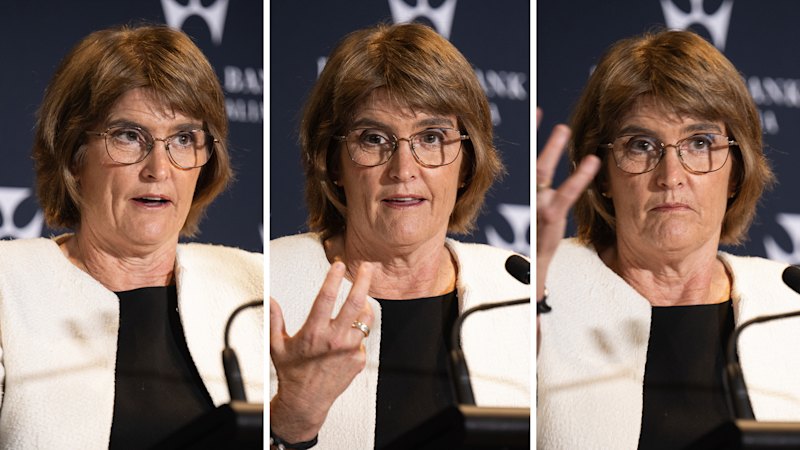
The Reserve Bank Governor, Michele Bullock, has issued a stark warning that the next five years could witness a slow global economic decline due to the unintended consequences of certain past policies. In an exclusive interview, Bullock expressed concerns that the fallout from Donald Trump‘s administration, particularly its global tariff strategy, could mirror the ongoing economic troubles faced by the United Kingdom following Brexit.
Bullock has gained attention as the first RBA governor to hold regular press conferences, aiming to clarify complex economic concepts for a broader audience. She shared insights on how recent global events, including the ongoing conflicts in Ukraine and Gaza, have contributed to significant economic upheaval. The RBA is preparing to release a report addressing the 51 recommendations from an independent review that prompted its most substantial changes since it began targeting a 2-3 percent inflation rate in the early 1990s.
In her comments, Bullock highlighted that while the bank typically focuses on economic developments in China and the broader Asian region, issues stemming from the United States could signal more challenging times ahead. She noted that her deputy, Andrew Hauser, has frequently referred to the ongoing economic turmoil in the UK as a consequence of Brexit. She remarked, “Andrew often talks about how people predicted disaster with Brexit. Well, it wasn’t immediate; it has been a slow, long-term issue.”
Bullock elaborated on her perspective that the current economic landscape is not characterized by immediate collapse but rather a gradual decline. “I think in five years’ time, we’re going to look back and say that was the start of the decay,” she stated. She emphasized that the issues are tied to national policies that have led to a self-imposed detachment from international supply chains, resulting in slower growth in world trade and increasing geopolitical tensions.
The RBA has maintained interest rates at 3.6 percent after implementing three cuts throughout 2025. Financial markets anticipate a rise in the cash rate to 3.85 percent by August. Bullock observed that during previous periods of rate cuts, commercial banks had not fully passed on reductions to borrowers. However, she noted that the recent three-quarter percentage point cut had been entirely transmitted to consumers.
Although there has been an uptick in spending for major events, such as concerts by AC/DC, Oasis, and Lady Gaga, Bullock indicated that many consumers are still cautious about their spending habits. They appear to be saving more money in offset and redraw accounts, demonstrating a tendency to balance large expenditures with more conservative financial behavior.
Critics of the RBA have pointed to federal and state government spending as a contributing factor to the bank’s challenges in maintaining inflation within its target range. Jim Chalmers, the Treasurer, is expected to announce a budget deficit of around $40 billion in his upcoming mid-year fiscal update. Bullock acknowledged that while governments are mindful of inflation when crafting budgets, they face numerous competing demands.
The governor emphasized the RBA’s singular focus on controlling inflation, stating, “I don’t think there’s any point in me telling governments what to do with fiscal policy. I don’t want them telling me what to do with monetary policy.” This separation of roles is crucial as the bank navigates the complexities of the current economic environment.
As part of the RBA’s reforms, Bullock has prioritized regular communication with the public. She expressed a commitment to making economic discussions accessible, aiming to explain policies in a manner that resonates with everyday Australians, including her own parents. “I have tried to explain things in terms that I hope if anyone was listening, I’ve tried to explain it so my mum would understand it,” she remarked.
Overall, Bullock’s insights reflect a cautious outlook for the global economy and underline the ongoing challenges that policymakers must navigate as they seek to stabilize growth and manage inflation in an increasingly complex international landscape.