Osmond Resources has reported a significant advancement in its exploration efforts at the Orión EU Critical Minerals Project located in southern Spain. Recent assay results from step-out drilling have confirmed the presence of high-grade deposits of titanium, zirconium, and rare earth elements, further establishing the project’s potential.
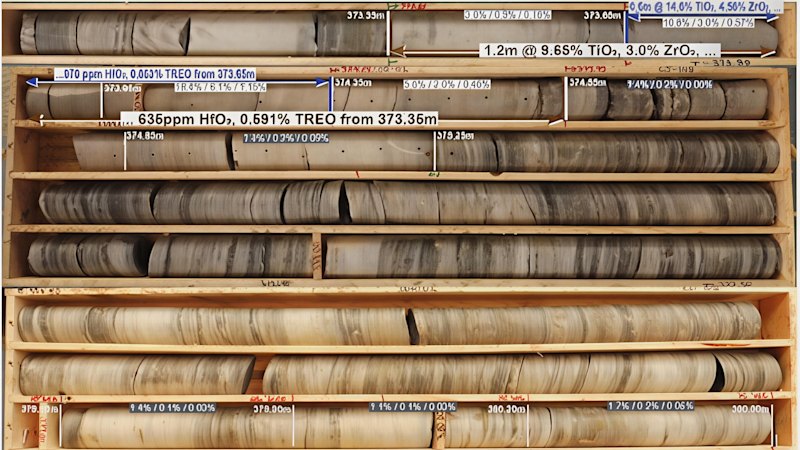
The latest diamond drill hole, designated SOR-02, successfully intersected a primary heavy minerals-rich quartzite layer at a depth of approximately 373 metres. This location is notably 1.7 kilometres from the initial discovery holes, AV-01 and AV-01bis. The results indicate that mineralisation extends over a considerable area, reinforcing the project’s viability.
Osmond Resources reported that the diamond drill core from SOR-02 revealed impressive assay results, including a 1.2-metre interval yielding 9.65 percent titanium dioxide, 3 percent zirconium dioxide, 783 parts per million (ppm) hafnium, and 0.73 percent total rare earth oxides (TREO). The assays highlighted an even richer 0.6-metre section, which graded 14.6 percent titanium dioxide and 4.56 percent zirconium dioxide, underscoring the promising nature of this mineral layer.
The Orión project, situated in Jaén Province, targets the Ordovician-aged Pochico Formation, characterized as a siliciclastic sequence that has undergone lithification over time. The stratabound nature of the mineralisation allows for predictable exploration, making the process more straightforward compared to many hard-rock systems.
This project aligns with the European Union’s critical raw materials list, containing vital minerals such as rutile, zircon, and monazite. These minerals serve as primary sources for key elements like titanium, zirconium, hafnium, and rare earth elements, all of which are integral to various high-tech industries. Titanium, for instance, plays a crucial role in aerospace, defence, and medical technologies, while hafnium is valued for its applications in nuclear control rods and high-temperature alloys.
Osmond Resources’ exploration has thus far involved seven diamond holes, totaling just under 2,000 metres, with two additional drilling operations currently underway. Every hole drilled has intersected the main Pochico quartzite, confirming that the richest mineralisation is found within the primary heavy mineral layer. Further assay results are expected soon, which may provide additional insights into the project’s potential.
The company’s early analysis suggests that the thickest and highest-grade sections of this mineral system are located near the original AV-01 drilling site. The step-out holes, including SOR-02, illustrate the strong continuity of mineralisation across zone one.
With ongoing export restrictions from China, Europe is increasingly focused on securing a domestic supply of critical minerals. Osmond’s discovery in Spain is thus emerging as a strategically significant asset. Looking ahead, the company plans to conduct resource estimation, scoping studies, and flowsheet development by March 2026, aiming to fast-track the development of what is becoming a globally significant critical minerals project.