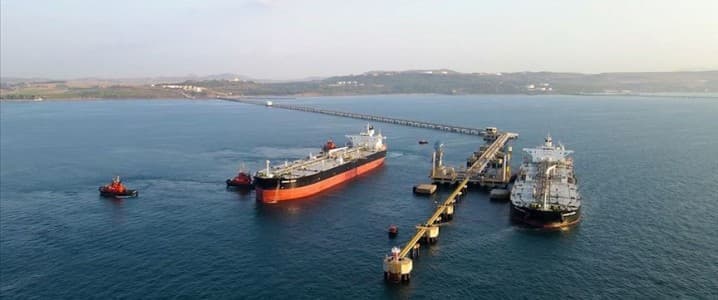
A recent oil shipment from the Kurdistan Region of Iraq (KRI) has marked a significant development in U.S. energy imports. An oil tanker delivered crude to a U.S. port at the end of last month, the first since the Iraq-Turkey Pipeline (ITP) reopened approximately two months ago. Industry analysts anticipate further shipments in the coming days, weeks, and months. While the U.S. has a legitimate demand for the medium-heavy sour Iraqi Kurdish blend, the resumption of these imports is intertwined with geopolitical considerations, especially following a recent rocket attack on the KRI’s Khor Mor gas field.
The Khor Mor field, located in the Sulaymaniyah region, experienced the most significant attack since a July drone strike that reduced the KRI’s oil output by around 150,000 barrels per day. Although the attack did not directly affect oil production, it disrupted the local energy supply, leading to widespread power outages. Senior security sources close to Iraq’s Oil Ministry suggest that Iran may be behind the attack, likely through its local proxies. This action serves two purposes: to deter the KRI from advancing its gas potential, which could diminish Iraq’s reliance on Iranian energy, and to further strain the relationship between Iraq and the U.S.
Despite the lack of definitive claims of responsibility for the Khor Mor attack, the implications are clear. The KRI has long been viewed as a more favorable investment opportunity for Western companies compared to the rest of Iraq. The ongoing investment climate has attracted significant interest, with firms like Shell and TotalEnergies making strides in the region. Shell is focused on converting associated gas from southern oilfields into fuel, while TotalEnergies has launched a $27 billion Gas Growth Integrated Project aimed at boosting gas production.
According to the International Energy Agency (IEA), Iraq’s proven reserves of conventional natural gas stand at 3.5 trillion cubic metres, ranking it 12th globally. However, about three-quarters of these reserves consist of associated gas. The IEA estimates that recoverable resources could be much larger, projecting up to 8.0 trillion cubic metres, of which approximately 30% is non-associated gas. This discrepancy highlights the potential for further exploration and development in the region.
The Kurdish Region, despite its potential, lacks adequate gas infrastructure, which has historically deterred investment. Currently, the region has only a limited gas pipeline network and processing facilities. This deficiency has left several promising fields, including Miran and Bina Bawi, underutilized and stranded. Iran has consistently sought to obstruct Western investment in the KRI, utilizing destabilization tactics to maintain its influence.
As the U.S. resumes oil imports from the KRI, it sends a clear message of its enduring commitment to the region. U.S. officials and their allies aim to reduce Iraq’s ties to Iranian, Chinese, and Russian companies associated with the Islamic Revolutionary Guards Corps. This strategy aligns with broader geopolitical objectives, including the use of the KRI as a base for monitoring Iranian activities.
The recent oil shipment from Iraq to the U.S. serves as a declaration of intent. It illustrates the U.S. and its allies’ determination to remain engaged in the KRI and Iraq. This engagement is expected to translate into increased exploration, development deals, and financial support throughout the oil and gas sectors. The presence of Western security personnel is also anticipated to continue, in line with international law regarding the protection of valuable assets abroad.
In summary, the resumption of oil imports from the KRI is not merely an economic transaction but a strategic maneuver in a complex geopolitical landscape. As one senior legal source connected to the U.S. Treasury Department noted, this oil shipment signifies a renewed commitment by the U.S. to remain actively involved in the region, reinforcing both energy security and broader geopolitical interests.