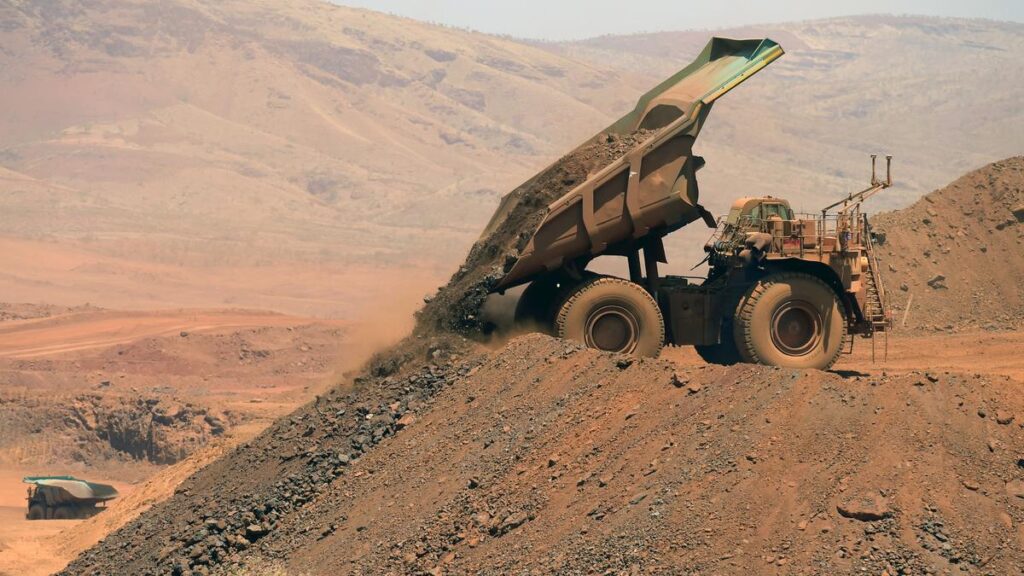
An autonomous haul truck dumps a load of rock in the mine pit at Rio Tinto Group's Gudai-Darri iron ore mine in the Pilbara region of Western Australia, Australia, on Thursday, Oct. 19, 2023. Rio Tinto is preparing for trials of battery-powered locomotives in Australia, where it uses giant autonomous trains ? the world?s largest and longest robots ? to transport iron ore across the vast Outback. Photographer: Carla Gottgens/Bloomberg
As Western Australia approaches 2026, the mining industry faces pivotal challenges and opportunities. Following a year of remarkable fluctuations in key commodities, industry analysts are forecasting significant changes for iron ore, gold, rare earths, and lithium, each vital to the region’s economy.
Iron Ore: Navigating Shifting Markets
Iron ore remains a cornerstone of Australia’s mining sector, generating over $100 billion annually in export income and contributing more than $8.5 billion in royalties to Western Australia. Predicted price declines have not materialized as expected; instead, the price averaged $103 per tonne in 2025, currently trading at around $104.
Despite this resilience, economists anticipate that prices will fall below $100 per tonne in 2026. The arrival of maiden iron ore shipments from the Simandou Mine in West Africa is expected to increase global supply, exerting downward pressure on prices. Additionally, uncertainties in China’s economy, the world’s largest consumer of iron ore, may further complicate the market landscape. A dispute between BHP and China’s main iron ore buyer regarding pricing could also impact Western Australian miners.
Gold: A Bull Market Continues
The gold market experienced a significant surge in 2025, with prices reaching unprecedented heights. In March, gold prices surpassed $3,000 per ounce, and they have since climbed to over $4,450 per ounce. Analysts predict that the price may breach the $5,000 mark in the coming year.
Factors contributing to this bullish trend include geopolitical tensions and economic instability, notably linked to actions from US President Donald Trump and the potential for conflict in oil-rich regions like Venezuela. As noted by Kenneth Wan, a portfolio manager at Drummond Knight Asset Management, the current bull market for gold is only about three years in, with historical trends suggesting it could continue for several more years. Even with a potential price decline, Western Australia’s gold miners maintain a healthy profit margin, making them well-positioned to navigate market fluctuations.
Rare Earths: Strategic Considerations
Rare earth elements have taken center stage in discussions about global supply chains, given their critical application in military technology and advanced manufacturing. Currently dominated by China, the rare earths market is at the heart of geopolitical tensions, particularly between the United States and China.
In response to concerns about reliance on Chinese supplies, the US and the Albanese Government signed a multi-billion-dollar agreement to develop rare earth mining and refining capabilities in Australia. While investment in this sector is growing, challenges loom. The dependence on Chinese manufacturing for essential mining and refining equipment may lead to significant cost overruns in the development of new projects.
Lithium: A Volatile Year Ahead
The lithium market in Western Australia has shown dramatic price volatility throughout 2025. Prices for spodumene concentrate fluctuated from approximately $820 per tonne at the start of the year to below $600 per tonne by mid-year, before rebounding above $1,200 per tonne towards the end of the year.
This revival is largely attributed to regulatory changes in China, which resulted in the revocation of numerous lithium mining permits. As demand for lithium continues to grow, particularly for energy storage solutions like the Tesla Powerwall, the industry faces uncertainty. Analysts remain divided on whether increased output from Chinese lithium mines will outpace the rising demand for energy storage in 2026, suggesting another year of volatility for this critical metal.
As Western Australia’s mining industry prepares for 2026, stakeholders must navigate a complex landscape shaped by external pressures, market dynamics, and evolving geopolitical realities. The outcomes of these factors could profoundly influence the region’s economic future, making it essential for industry leaders to remain vigilant and adaptable.