



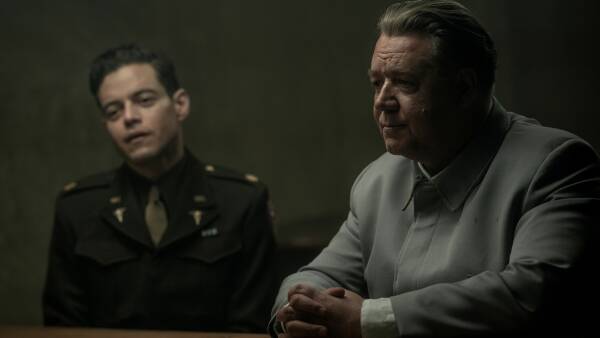
The latest cinematic exploration of World War II, titled Nuremberg, showcases a riveting performance by Russell Crowe as Hermann Goering, one of the most notorious figures in the Nazi regime. Directed and written by James Vanderbilt, the film opens on May 8, 1945, the final day of the war in Europe, as American soldiers come across a Nazi vehicle in the streets, revealing Goering inside.
Crowe’s portrayal of Goering is chilling, particularly when he adopts a surprisingly pleasant demeanor. Much of his performance is delivered in German, while his English dialogue maintains a consistent German accent that does not detract from the intensity of his character. Goering’s capture prompts a critical dilemma: with many leading Nazi officials either dead or in hiding, he becomes the highest-ranking member still alive, raising urgent questions about accountability and justice.
The narrative shifts focus to Michael Shannon, who plays American Supreme Court Justice Robert Jackson. Jackson is tasked with prosecuting Goering and other senior Nazis for war crimes at an international tribunal. This unprecedented legal challenge unfolds against the backdrop of the newly established Nuremberg Trials, organized by the United States in collaboration with the United Kingdom, France, and Russia.
In a compelling subplot, psychiatrist Douglas Kelley, portrayed by Rami Malek, is brought in to analyze the psychological profiles of the captured Nazis. Kelley sees the opportunity as a chance to create a groundbreaking book that could illuminate the motivations of individuals like Goering. He is assisted by American soldier Howie Triest (played by Leo Woodall), who aids in communication with the German officials.
As the film progresses, it initially appears to adopt a narrative typical of many World War II films, featuring themes of American heroism. However, it evolves into a complex exploration of psychological warfare between Kelley and Goering, with both characters testing boundaries and challenging each other. The film maintains engagement through its emphasis on dialogue and character development, despite a limited variety in settings.
A particularly harrowing segment of the film includes real footage from concentration camps, serving as a stark reminder of the atrocities committed during the Holocaust. This footage is not brief and extends for several minutes, fulfilling a significant narrative purpose. Nuremberg not only recounts historical events but also draws poignant parallels to contemporary issues.
Crowe’s Goering reflects a dangerous charisma that once captivated many, echoing sentiments that resonate with current political climates. As Goering states, he made others “feel German again,” a phrase that invites reflection on similar rhetoric in modern political discourse. Kelley’s warnings about the potential for authoritarianism in the United States during the time remain relevant, raising questions about vigilance in today’s society.
Overall, Nuremberg is a compelling examination of justice, accountability, and the psychological dimensions of extremism. The film’s strong performances and thought-provoking themes ensure its significance in both historical and contemporary contexts.