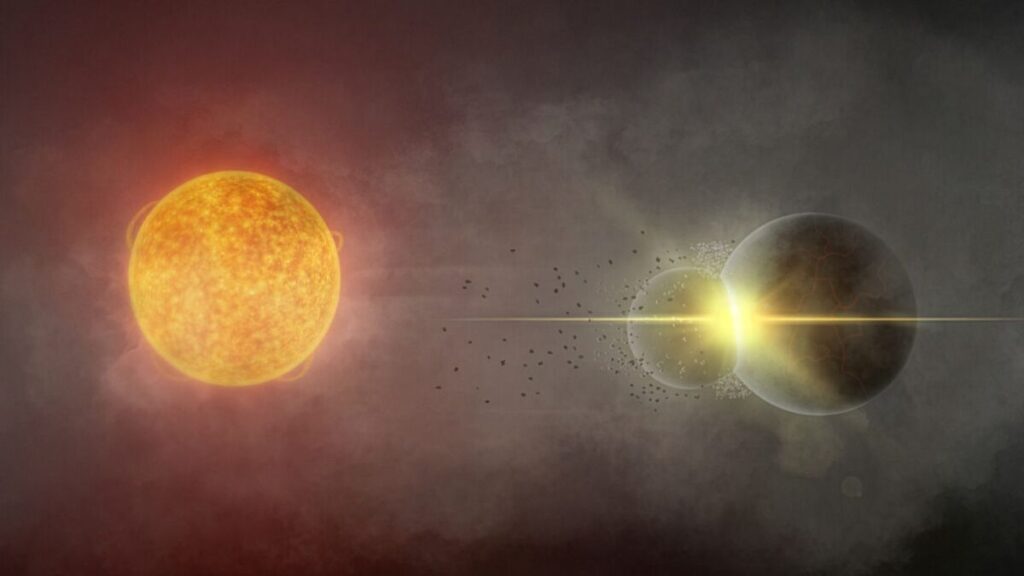
Astronomers have observed what appears to be the dramatic collision of two exoplanets, a rare event that could resemble the formation of Earth and its Moon. The incident, detected approximately 2,200 light-years from Earth, has sparked significant excitement within the scientific community, leading experts to draw parallels to historical cosmic events.
Using advanced observational techniques, a team from the University of California, Berkeley, in collaboration with NASA, captured images of the two planets, designated WASP-178b and WASP-178c, seemingly merging. This extraordinary observation offers a unique opportunity to study planetary formation and the dynamics of celestial bodies.
Significance of the Discovery
The collision may provide insights into the processes that shaped our own solar system. According to Dr. Benjamin Zuckerman, a professor of astronomy at the University of California, “There are so many similarities to the impact that created the Earth and Moon.” This statement underscores the potential implications of the findings for understanding planetary evolution.
The collision is believed to have occurred in a binary star system, where the gravitational forces between the stars can significantly influence the orbits of surrounding planets. The study of such systems is crucial for unraveling the complexities of planetary interactions and their eventual fates.
Future Research Directions
Following this remarkable event, astronomers plan to conduct further observations to analyze the aftermath of the collision. By studying the debris and remnants, researchers hope to gain a clearer understanding of what happens when planets collide and the subsequent effects on their environments.
Data collected from this observation will contribute to a broader understanding of exoplanetary systems and the potential for similar events in other star systems. As technology advances, astronomers anticipate more discoveries that could illuminate the mysteries of our universe.
The excitement surrounding this collision highlights not only the capabilities of modern astronomy but also the endless possibilities for future exploration. The findings from WASP-178b and WASP-178c may pave the way for new theories regarding planet formation and the conditions necessary for life beyond Earth.