




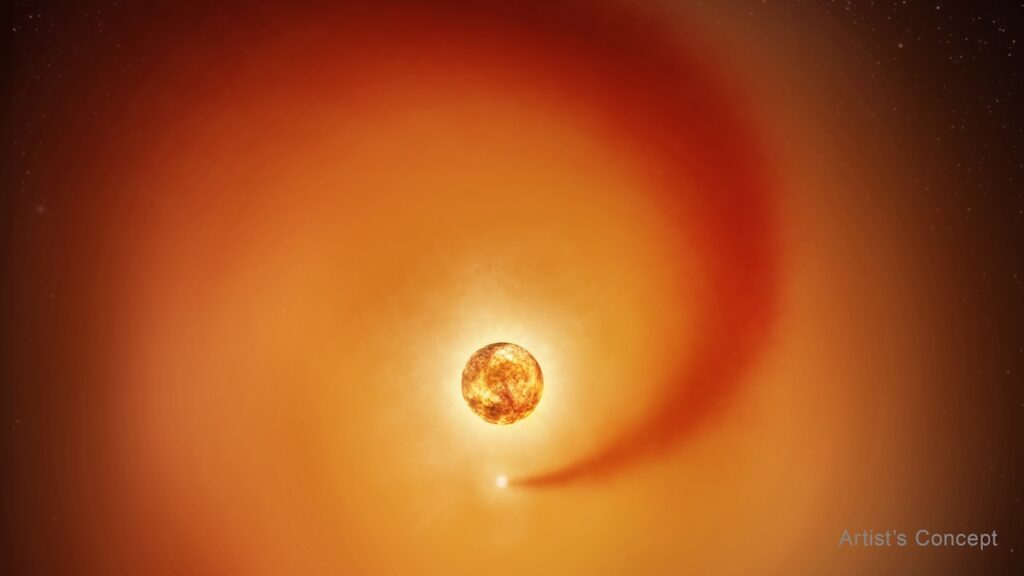
A significant discovery in the field of astronomy has confirmed the existence of a small companion star orbiting the well-known red giant, Betelgeuse. After nearly eight years of meticulous observation, astronomers have finally elucidated one of the star’s longstanding mysteries, revealing that this companion star, named Siwarha, has a discernible impact on Betelgeuse’s atmospheric dynamics.
The study leveraged data from several prestigious astronomical facilities, including the Hubble Space Telescope, the Fred Lawrence Whipple Observatory in Arizona, and the Roque de Los Muchachos Observatory in the Canary Islands. The findings indicate that Siwarha creates a significant “wake” as it traverses Betelgeuse’s atmosphere, a phenomenon that has now been directly observed.
Understanding Betelgeuse’s Variability
Betelgeuse has long intrigued scientists with its unpredictable light variations. Observations reveal two distinct cycles influencing its brightness. The first cycle lasts approximately 400 days and is attributed to internal pulsations within the star. The second cycle, which spans around 2,100 days, has been more challenging to explain until now. The prevailing hypothesis suggests that this cycle corresponds with the orbit of Siwarha, which travels closely around the red supergiant.
Astronomer Andrea Dupree from the Harvard & Smithsonian Center for Astrophysics stated, “It’s a bit like a boat moving through water. The companion star creates a ripple effect in Betelgeuse’s atmosphere that we can actually see in the data.” This direct observation of the star’s wake provides crucial insights into how such massive stars evolve and interact with their environments.
Impact on Stellar Evolution Understanding
Interestingly, Siwarha does not dim the light of Betelgeuse; rather, it influences the spectrum of light emitted by the star, particularly in the ultraviolet wavelengths associated with ionized iron. When Siwarha passes in front of Betelgeuse, an increase in iron emissions is detected. Conversely, once it eclipses the star, the gas trailing from Siwarha begins to absorb these wavelengths, resulting in a reduced light peak. This pattern will repeat approximately every 5.77 years until Siwarha re-emerges, expected to occur in August 2027.
Dupree emphasized the significance of this discovery, stating, “Finding the wake from its companion means we can now understand how stars like this evolve, shed material, and eventually explode as supernovae.” The implications of this research extend beyond Betelgeuse, potentially informing scientists about the lifecycle of other massive stars in the universe.
The findings of this comprehensive study have been accepted for publication in The Astrophysical Journal and are also available on the preprint server arXiv. This confirmation marks a pivotal moment in astronomical research, enhancing our understanding of stellar dynamics and the complex behaviors of massive stars like Betelgeuse.