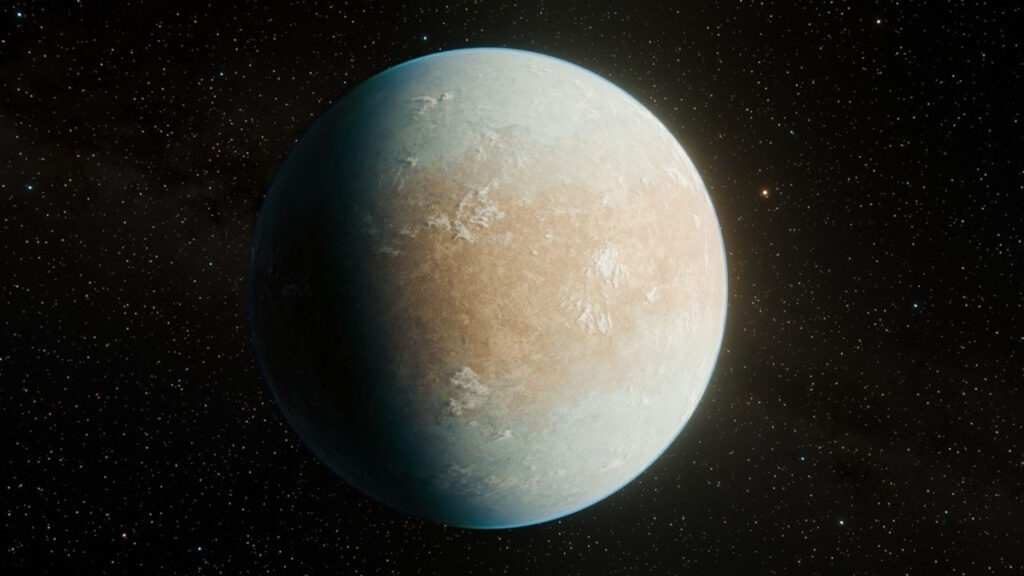
Astronomers have made a groundbreaking discovery of a potentially habitable exoplanet, named HD-137010 b, located less than 150 light-years from Earth. This rocky world, characterized by frigid temperatures, bears striking similarities to our planet and may reside within the habitable zone of its star, raising intriguing possibilities about the potential for liquid water.
Details of the Discovery
According to a recent study published in The Astrophysical Journal Letters, HD-137010 b is approximately 1.2 times the mass of Earth and orbits a cooler, dimmer star known as HD-137010. This K dwarf star is about 70 percent the size and mass of our Sun, and it has a significantly longer main-sequence lifetime due to its slower hydrogen consumption. Researchers estimate that this star will outlive our solar system.
HD-137010 b completes its orbit around its star every 355 days, suggesting a year length similar to that of Earth. Based on its orbital characteristics, researchers believe there is a 51 percent chance that this exoplanet lies within the habitable zone where conditions may allow liquid water to exist.
Method of Detection and Future Observations
The detection of HD-137010 b was achieved using data from NASA’s retired Kepler space telescope, which employed the transit method. This technique involves monitoring a star for periodic dimming, which indicates that a planet is passing in front of it. Thus far, astronomers have observed only one transit, making additional observations essential to confirm the planet’s status.
“This is the first planet candidate with Earth-like radius and orbital properties transiting a Sun-like star bright enough for substantial follow-up observations,” the researchers stated.
To fully establish HD-137010 b as a confirmed exoplanet, multiple transits must be documented, a process that could take several years. Future observations may require next-generation observatories, such as the European Space Agency’s PLATO.
Despite the challenges, the discovery of HD-137010 b shows promise. Researchers assert that it demonstrates the possibility of detecting temperate and cool Earth-sized planets orbiting Sun-like stars through single transits.
Climate Conditions and Implications for Life
Despite the potential for habitability, HD-137010 b may be exceptionally cold, receiving less than a third of the energy that Earth receives from the Sun. Researchers estimate surface temperatures could range between -68 and -85 degrees Celsius (-90 to -121 degrees Fahrenheit), making it colder than Mars. However, there remains a possibility for favorable atmospheric conditions that could allow liquid water to exist.
Given what is known about other Earth-sized exoplanets in habitable zones, the researchers suggest that a moderately CO2-rich atmosphere could facilitate the presence of liquid water on HD-137010 b’s surface. Yet, if the planet’s CO2 levels mirror those of Earth, it might be trapped in a ‘snowball’ climate, resulting in a fully glaciated surface that reflects incoming starlight and further reduces its temperature to around -100 degrees Celsius.
Interestingly, HD-137010 b may not be alone. Although it currently appears isolated, evidence from other exoplanet systems suggests that additional planets could exist within or beyond its orbit, potentially forming a solar system-like structure.
The discovery of HD-137010 b raises important questions about the nature of habitability and the potential for life beyond our solar system. While a frozen planet may seem inhospitable, Earth’s own geologic history includes periods when it was similarly cold, demonstrating that life can adapt in unexpected environments. As research continues, the scientific community remains eager to uncover the mysteries surrounding this fascinating exoplanet.