




A team of astronomers has achieved a significant milestone by continuously observing an active region on the Sun for over three months. This unprecedented observation period, which tracked the region from its emergence to its dissipation, could enhance predictions of space weather, crucial for satellite operations and communication systems.
The active region, designated as NOAA 13664, originated on the far side of the Sun on April 16, 2024. It rotated into view in May, coinciding with a series of intense geomagnetic storms that affected Earth. These storms resulted in spectacular auroras visible in areas typically unaccustomed to such displays. The region rotated out of sight on July 18, 2024, appearing calmer when it became visible again.
This continuous observation lasted approximately 90 days, with astronomers losing sight of NOAA 13664 only briefly between April 26 and April 29. According to Ioannis Kontogiannis, a solar physicist at ETH Zurich in Switzerland, “This is the longest continuous series of images ever created for a single active region. It’s a milestone in solar physics.”
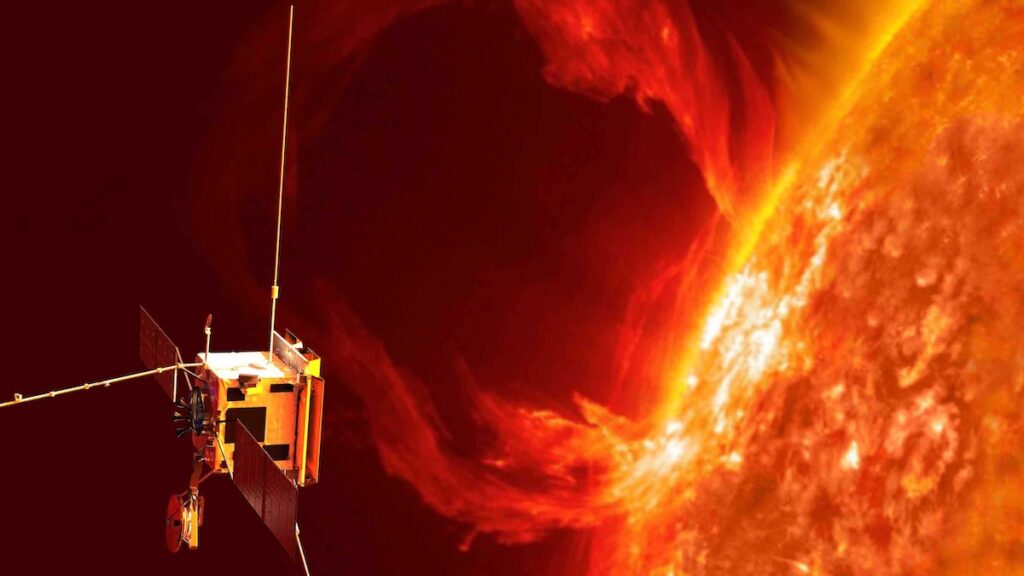
Typically, solar regions are visible from Earth for about two weeks due to the Sun’s rotation, which takes approximately 28 days. In this case, the collaboration of two spacecraft allowed for continuous monitoring. The Solar Orbiter, launched by the European Space Agency (ESA) in 2020, observed the region from the far side, while NASA’s Solar Dynamics Observatory provided a vantage point from Earth’s orbit.
The insights gained from this extended observation period enable researchers to analyze the evolution of the active region’s magnetic fields and understand how these changes drive solar activity. Solar storms are not just beautiful phenomena; they pose risks to technology on Earth. Understanding these storms is vital for predicting potential disruptions to satellites, power grids, and communication networks.
The findings from this research have been detailed in the journal Astronomy & Astrophysics. As astronomers continue to refine their understanding of solar dynamics, their efforts will contribute to improved forecasting of space weather events, allowing society to better prepare for the impacts of solar activity.